
The definitive guide to California Probate Code §1061 formats.
A California fiduciary accounting isn't a spreadsheet of what an account is worth today — it's a structured proof laid out the way the Probate Code demands. Section 1061 dictates the shape of that proof, and getting the shape wrong can send an otherwise-correct accounting back from the bench. Here's the format, line by line: the summary, the schedules that feed it, and the one rule that governs all of it.
The short version
- §1061 prescribes the Summary of Account — the cover page that reconciles the whole filing.
- The summary has two sides: charges (what the fiduciary is accountable for) and credits (what discharges that accountability). Total charges must equal total credits — to the penny.
- §1062–1063 require the supporting schedules — receipts, gains and losses, disbursements, distributions, and property on hand — each of which feeds one line on the summary.
- Assets are carried at carry value (usually inventory value at death) to balance; market value is shown separately under §1063.
- Categories that don't apply may be omitted, but the structure stays substantially the same.
- When it applies: to any account filed with the court — always in a probate (decedent's) estate, and also in a conservatorship, guardianship, or court-involved trust. A trustee's private accounting to beneficiaries follows §16062–16063 instead.
The one rule everything serves: charges equal credits
Before the format makes sense, start with what it's for. A §1061 accounting exists to prove a single equation: everything the fiduciary was accountable for equals everything that discharges that accountability. In the code's language, total charges must equal total credits. Not approximately — exactly, to the last cent.
That equality is the whole exercise. Every schedule, every column, every line item is machinery in service of making those two totals tie. Miss by a dollar and the accounting isn't finished, no matter how honest the numbers are. (For the underlying logic of the proof, see what a fiduciary accounting is and the fully worked sample accounting.)
Watch out — "charges" and "credits" are not the bank's words. On a bank statement, a credit adds to your balance. In a §1061 accounting it's the reverse: a credit is what reduces the fiduciary's accountability — money that legitimately left, plus the property still on hand. Charges are what the fiduciary had to work with; credits are the account of where it all went. The vocabulary trips up nearly everyone the first time.
The §1061 Summary of Account, line by line
Section 1061(b) sets out the format of the summary. It's two columns. The left side totals what the fiduciary is charged with; the right side totals what credits against that charge. Here is the full template — inapplicable categories may be dropped, but what remains sits in this order:
| Charges (accountable for) | Credits (discharged by) |
|---|---|
| Property on hand at the beginning of the account (or Inventories) | Disbursements (Schedule D) |
| Additional property received (or Supplemental Inventories) | Losses on sale or other disposition (Schedule E) |
| Receipts (Schedule A) | Net loss from trade or business (Schedule F) |
| Gains on sale or other disposition (Schedule B) | Distributions to beneficiaries (Schedule G) |
| Net income from trade or business (Schedule C) | Property on hand at the close of account (Schedule H) |
| = Total Charges | = Total Credits |
Read it as a story. The fiduciary began with property on hand (or, in the first account, the inventory). More property may have arrived. Money came in as receipts, assets sold for gains, a business threw off net income — all charges. Against that, money went out as disbursements, some assets sold at a loss, a business ran at a net loss, beneficiaries were paid, and whatever's left sits as property on hand at the close. When the two totals match, the account proves itself.
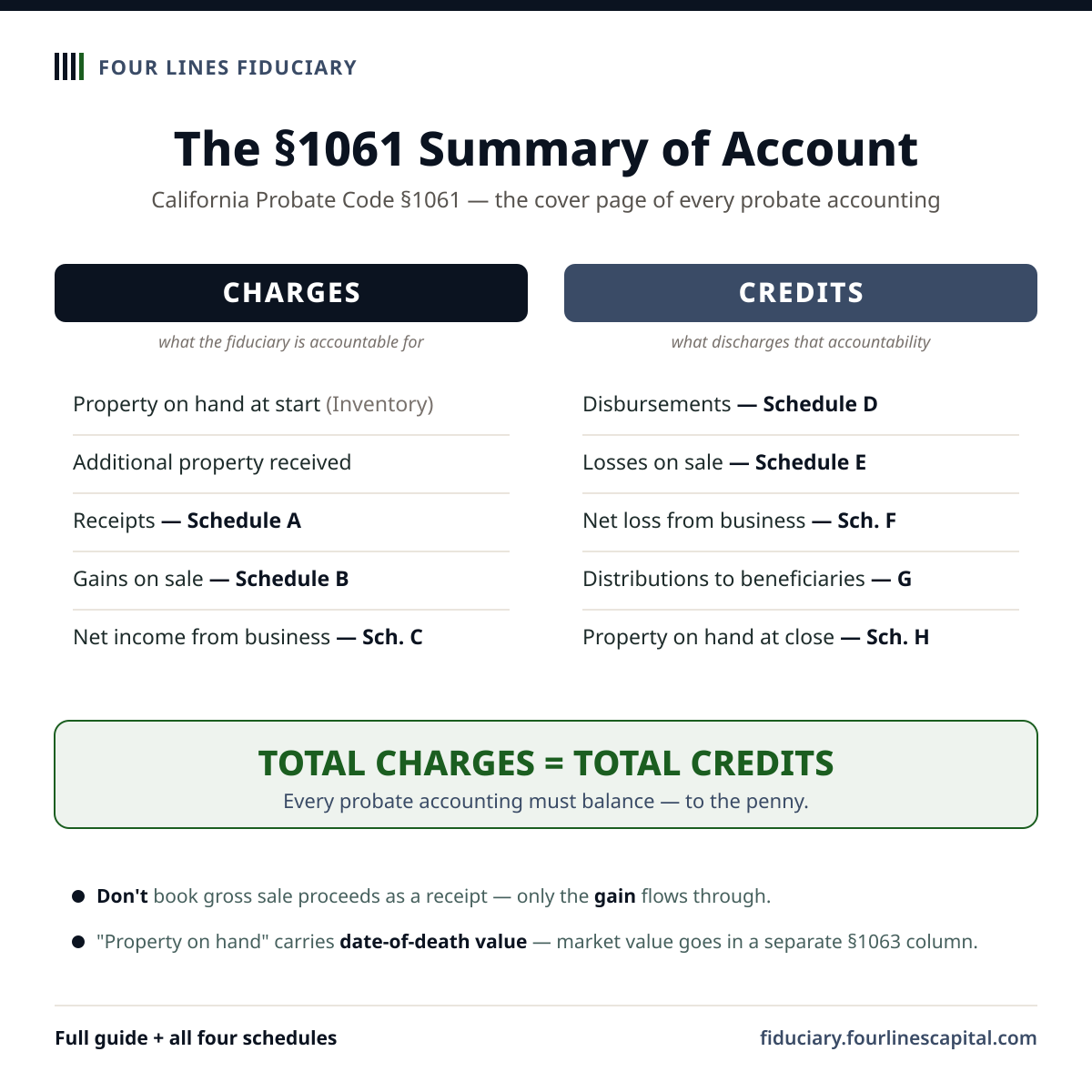
Hint — omit categories, keep the skeleton. Most accountings never touch a trade or business, so Schedules C and F simply don't appear. §1061 allows that: a category that doesn't apply may be left out. What you may not do is reorder the framework or invent your own headings. The examiner reads these in a known sequence; keeping to it is half of looking court-ready.
The supporting schedules (§1062 & §1063)
The summary is a cover page. Every number on it comes from a supporting schedule required by §1062 and §1063, and the total on each schedule is the exact figure carried up to its line on the summary. Nothing floats; every dollar traces to a source.
Schedule of Receipts (Schedule A)
Every dollar that came in during the period, itemized — the schedule must show the date, source, purpose, and amount of each receipt, so any reader can trace it back to a statement. And where there is an income beneficiary, the schedule must strictly separate principal receipts from income receipts.
- Principal receipts are returns of the asset itself — a refund or an uncashed check the decedent owned at death, a return of capital, proceeds attributable to the corpus.
- Income receipts are what the assets earned during administration — dividends, interest, rents.
That split isn't cosmetic. A lifetime income beneficiary is owed the income; the remainder beneficiaries take the principal. Blur the line and you misstate who is owed what. (See principal vs. income, explained.)
Schedule of Disbursements (Schedule D)
Everything that went out that wasn't a payment to a beneficiary — taxes, insurance, repairs, professional and fiduciary fees, administration costs. Each line carries the date, payee, purpose, and amount, listed chronologically. Payments to the people who inherit belong on the Distributions schedule, not here.
Schedule of Gains and Losses (Schedules B and E)
When an asset is sold or otherwise disposed of, this schedule reports only the difference between the asset's original appraised value and the gross sales price — the net gain or loss — not the whole proceeds. A gain lands on the charges side (Schedule B); a loss lands on credits (Schedule E).
Watch out — don't double-count the proceeds. When a stock carried at $84,300 sells for $97,650, only the $13,350 gain flows through the summary. The $97,650 is not also booked as a receipt — the cash simply moved from one asset (the stock) into another (the account holding the proceeds). Booking the gross proceeds as a receipt is the single most common rookie cause of a summary that won't balance.
Property on Hand (Schedule H)
The closing schedule lists everything the fiduciary still holds at the end of the period, stated at carry value — usually the inventory value at the date of death. That carry-value total is what ties to the credits side of the summary, and it becomes next period's opening "property on hand."
But §1063 requires more than the carry value. The schedule must also show the current estimated market value at the end of the period — typically in a separate column — so the court can see both the balancing figure and what the assets are actually worth today.
Carry value vs. market value: the two-number problem
This is where do-it-yourself accountings most often derail, so it's worth stating plainly. A §1061 accounting lives with two different valuations for the same asset, and they do two different jobs.
| Carry value | Market value | |
|---|---|---|
| What it is | Fixed value on the books — usually inventory value at date of death | Current estimated value at the end of the period |
| What it's for | Balancing the summary — charges to credits | Informing the court what assets are worth now |
| Where it lives | Every schedule and the summary total | The separate column §1063 requires on Property on Hand |
| Does it touch the balance? | Yes — it is the balance | No — purely informational |
Drop today's brokerage statement balance into the schedule where carry value belongs and the summary stops tying — because market swings were never receipts or disbursements. Carry value and market value are two numbers that live in two different places, and conflating them is the fastest way to a rejected filing. (More on this in carry value vs. market value.)
Why standard bookkeeping produces a rejected accounting
A frequent, expensive assumption is that a general business bookkeeper or a clean QuickBooks file gets you most of the way to a §1061 accounting. It doesn't — usually it produces something the court rejects, because standard accounting principles are built for a different purpose than fiduciary duty. Here's where the two frameworks diverge:
| Standard bookkeeping (e.g. QuickBooks) | Fiduciary (§1061) accounting | |
|---|---|---|
| Basis | Cash or accrual (your choice) | Cash basis only — actual receipts and disbursements |
| Asset valuation | Historical cost / book value (what was paid) | Carry value — the value at the date of death, held fixed |
| Receipts | Grouped as general "income" | Strictly separated: principal vs. income |
| Asset sales | Gain/loss vs. book (cost) value | Gain/loss vs. the date-of-death appraisal |
| End goal | Profit & loss / tax preparation | Balancing charges to credits, to the penny |
None of this means QuickBooks is bad software — it means it's built to answer a different question. Two things trip people up. First, an existing QuickBooks file can't simply be repurposed: its figures are the decedent's lifetime cost basis, often on an accrual footing, not the date-of-death carry values and actual cash receipts and disbursements a §1061 accounting is assembled from. Second — and this is the part people miss — even if you open a fresh file and diligently enter everything on the probate basis (opening at inventory values, cash in and cash out), QuickBooks still isn't designed to produce the §1061 output. It generates a profit-and-loss statement and a balance sheet; it does not generate a Summary of Account that balances charges against credits, holds a hard principal/income line, and states each gain against its appraised value. You can force the inputs in — you can't make it emit the format. That's why books kept for the tax return almost always have to be reworked, or rebuilt in the right framework, before they'll survive a probate examiner. (See can QuickBooks do a trust accounting? and can a CPA do it?)
Watch out — the format is not optional. Correct numbers in the wrong format still get sent back. A narrative summary, market-value asset totals, or income and principal lumped together will draw an objection or a bounce even if every dollar is honest. The court expects its schedules, in its order, tied to the penny.
Why a chatbot can't produce this — and what actually can
It's tempting to feed fifty pages of messy, redacted bank statements to a general-purpose AI and ask it to "prepare the accounting." Don't. A large language model is probabilistic — it predicts the next most-likely word. It is not a calculator, and it has no concept of an equation that must balance. Ask one to reconcile fifty pages and it will confidently hand you a summary that looks like a §1061 accounting and quietly fails to tie, with hallucinated figures sitting between real ones.
The right architecture doesn't ask a language model to do arithmetic. It decouples the two jobs:
- Data extraction. Vision and OCR are used strictly to pull structured data — dates, payees, amounts — out of messy PDFs and scanned statements. This is a reading task, and it's where machine assistance genuinely helps.
- Deterministic math. That structured data is then handed to a deterministic, rules-based financial engine — one that categorizes principal versus income, applies carry value, and balances the schedules to the exact penny. Rules, not probabilities. The same inputs always produce the same balanced output.
Extraction and math are different problems, and conflating them is why a chatbot "reconciliation" can't be trusted. Separate them and machine speed on the reading half is paired with courtroom-grade certainty on the math half. (For where AI helps and where it creates exposure, see AI for trust & estate attorneys.)
Common questions
What does California Probate Code §1061 require?
§1061 prescribes the format of the Summary of Account — the cover page that reconciles the filing. It lists charges (property on hand at the beginning, additional property received, receipts, gains on sale, and net income from a trade or business) against credits (disbursements, losses on sale, net loss from a business, distributions, and property on hand at the close). Total charges must equal total credits. Categories that don't apply may be omitted, but the structure stays substantially the same.
Does §1061 apply to trusts, or only probate estates?
§1061 governs any account filed with the court under the Probate Code (§1060). That is always the case in a probate (decedent's) estate, and it also covers conservatorship and guardianship accounts (on Judicial Council GC-400/405 forms) and a trust account when it is presented to the court. A trustee's private accounting to beneficiaries is different — it follows Probate Code §16062–16063, not the §1061 court format.
What's the difference between charges and credits?
Charges are everything the fiduciary is accountable for — starting property, receipts, gains. Credits are everything that discharges that accountability — disbursements, losses, distributions, and property still on hand. It's the opposite of a bank statement, where a credit adds to your balance. The two totals must tie to the penny.
Which schedules back the summary?
Under §1062–1063: Receipts (A), Gains on sale (B), net income from a business (C), Disbursements (D), Losses on sale (E), net loss from a business (F), Distributions (G), and Property on hand at the close (H). Each schedule's total feeds one line on the summary.
What is carry value vs. market value?
Carry value is the fixed value an asset is carried at — usually inventory value at date of death — and it's what balances the summary. §1063 also requires the current estimated market value at the end of the period, shown separately. Carry value ties to the balance; market value is informational only.
Can I just use QuickBooks or a general bookkeeper?
Usually not without rework. QuickBooks carries assets at historical cost, runs on a cash or accrual basis, lumps inflows into income, and produces a P&L — not a Summary of Account. A §1061 accounting is cash-basis, carries assets at their date-of-death value, splits principal from income, and balances charges against credits. You can enter probate-basis data into QuickBooks, but it isn't built to output the §1061 format, so books kept for taxes generally have to be reworked before a court will accept them.
Need a §1061 accounting that balances to the penny?
We turn disorganized bank and brokerage statements into court-ready California §1061 (and Florida Rule 5.346) accountings on a flat-fee basis. Send us your messiest file for a free review — we'll tell you the scope and quote a fixed price before you commit a dollar.
This is general information about the California Probate Code §1061 accounting format, not legal or tax advice, and citations can change. Confirm the applicable rules and local requirements with your attorney or the court.