
A sample trust (and estate) accounting, filled in line by line — and how to read it
A judge can reject a fiduciary accounting for being off by a single dollar. Not for being wrong about the money — for not tying out. That's the part nobody shows you: an accounting isn't a balance, a statement, or a spreadsheet of what an account is worth today. It's a structured proof. It demonstrates that what the fiduciary started with, plus everything that came in, equals everything that went out plus what's still on hand — to the penny.
This page does two things. First it builds one in front of you: a balanced summary, then each schedule that feeds it, with realistic illustrative figures so you can see how the numbers connect. Then it shows you how to read one — the single arithmetic check that matters, and the five red flags worth a closer look. Whether you're preparing an accounting or you've been handed forty pages and told to approve them, this is the whole skeleton.
The short version
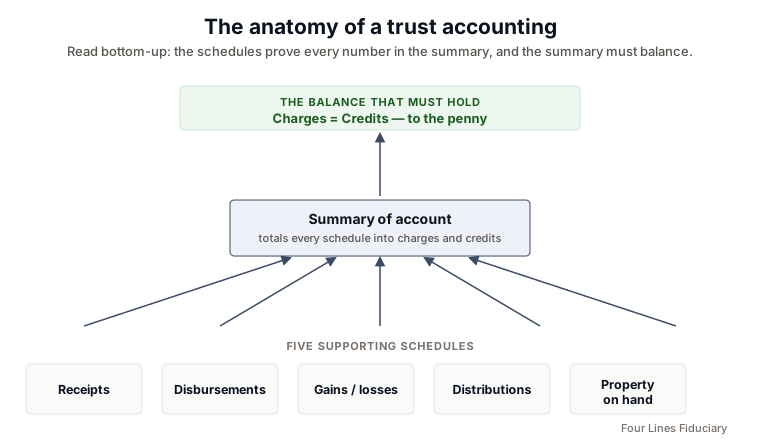
- A fiduciary accounting is a summary backed by supporting schedules, and the summary must balance to the penny.
- The summary has two sides: charges (what the fiduciary is accountable for) and credits (what discharges that accountability). Charges = credits.
- Every schedule total feeds one line on the summary. Nothing floats; every dollar traces to a source.
- Estate or trust, it's the same skeleton. A personal representative closing probate and a trustee rendering an annual account use the identical proof — only the cover format and the audience change.
- A balanced accounting can still hide a wrong number. After it balances, read the detail for five red flags.
Every figure below is hypothetical and illustrative. It comes from no real matter. The numbers carry cents and uneven amounts on purpose — a real accounting rarely runs in clean thousands — but they're simplified to keep the structure visible.
Estate or trust: the same skeleton
Before the numbers, clear up the most common confusion: an estate accounting (filed by a personal representative to close probate) and a trust accounting (rendered by a trustee, often annually) are the same document type. Same charges-and-credits proof, same supporting schedules, same principal/income split. What differs is who reads it and on what clock — the court and the distributees for an estate; the beneficiaries for a trust. (See estate vs. trust vs. tax vs. GAAP for who owes which.)
So read the example below as either. We'll call it the Estate of Margaret Chen for concreteness; a trustee's annual account of the Chen Family Trust would look line-for-line the same.
The summary of account: charges on one side, credits on the other
The summary is the cover page everything else supports. Charges are what the fiduciary is accountable for: property held at the start, everything received, and gains when assets sold. Credits are what discharges that accountability: what was spent, lost on a sale, paid out to beneficiaries, and what remains on hand at the close. The two columns tie out exactly.
Here's a hypothetical one-year period for the Chen matter:
| Charges (accountable for) | Amount | Credits (discharged by) | Amount |
|---|---|---|---|
| Property on hand, beginning (Sch. E prior) | $1,395,650.00 | Disbursements (Schedule B) | $45,444.50 |
| Receipts (Schedule A) | $46,977.61 | Losses on sale (Schedule C) | $0.00 |
| Gains on sale (Schedule C) | $13,350.00 | Distributions (Schedule D) | $70,000.00 |
| Property on hand, ending (Schedule E) | $1,340,533.11 | ||
| Total charges | $1,455,977.61 | Total credits | $1,455,977.61 |
Charges of $1,455,977.61 equal credits of $1,455,977.61. That equality is the exercise. Get it, and the rest is presentation. Miss it by a dollar and the accounting isn't done. (For why the format exists at all, see what a fiduciary accounting is.)
Watch out — "charges" and "credits" don't mean what your bank means. On a bank statement a credit adds to your balance. In an accounting it's the opposite: a credit is what reduces the fiduciary's accountability — money that legitimately left, plus the assets still on hand. Charges are what the fiduciary had to work with; credits are their account of where it all went. Don't let the vocabulary throw you.
Schedule A — Receipts
Everything that came in during the period: interest, dividends, rents, and the like. Each line carries a date, a source, and an amount, so any reader can trace the dollar back to a statement.
| Date | Source | Amount |
|---|---|---|
| 03/15 | Brokerage dividends | $14,832.17 |
| 06/30 | Bank interest | $1,205.44 |
| Various | Rental income, 1428 Oak Ave. | $28,800.00 |
| 08/22 | Return of capital, XYZ Partnership | $2,140.00 |
| Total receipts | $46,977.61 |
That $46,977.61 is the exact figure carried up to the charges side of the summary. This is the pattern for every schedule: the total on the schedule and the line on the summary are the same number. (Note the last line — a return of capital is a receipt, but it's principal, not income. More on that below.)
The reality check on Schedule A. We showed four lines so your eyes wouldn't glaze over. A real $1.4M estate does not receive one tidy $14,832.17 dividend. Schedule A runs 100 to 200 lines: twelve straight months of $18.41 reinvestment drips across four sub-accounts, a reversed wire fee, a $412 escrow refund from a 2019 mortgage payoff, two uncashed Medicare reimbursement checks. Miss a single $18.41 entry and your summary is off by $18.41 at year-end — and you will spend three days hunting the one penny that won't tie. The skeleton is simple. The volume is the job.
Schedule B — Disbursements
What went out that wasn't a payment to a beneficiary: taxes, insurance, repairs, professional and fiduciary fees, administrative costs.
| Date | Payee / purpose | Amount |
|---|---|---|
| 04/10 | County property taxes, 1428 Oak Ave. | $9,142.00 |
| 07/01 | Property insurance | $3,265.00 |
| 08/14 | Roof repair, 1428 Oak Ave. | $6,800.00 |
| 09/20 | Accountant and legal fees | $11,500.00 |
| 12/01 | Fiduciary fee | $14,250.00 |
| Various | Filing fees, postage, bank charges | $487.50 |
| Total disbursements | $45,444.50 |
The $45,444.50 feeds the credits side. Payments to people who inherit go on their own schedule, not here.
Schedule C — Gains and losses on sale
When an asset sells, this schedule reports only the difference between its carry value and the sale price — not the whole proceeds. Here a stock position carried at $84,300.00 sold for $97,650.00:
| Asset | Carry value | Sale price | Gain / (loss) |
|---|---|---|---|
| 1,500 sh. Example Co. | $84,300.00 | $97,650.00 | $13,350.00 |
The $13,350.00 gain lands on the charges side. A loss would land on credits. Note what does not happen: the $97,650.00 of proceeds is not also booked as a receipt. The cash simply moves from one asset (stock) into another (the bank account holding the proceeds). Only the gain or loss flows through the summary. Double-counting the gross proceeds is the single most common rookie cause of a blown summary.
The carry-value trap: step-up vs. carryover. In this estate, the carry value is not the decedent's 1994 purchase price. Assets passing through an estate — or a revocable living trust that becomes irrevocable at death — get a stepped-up basis to date-of-death value under IRC §1014. So the work in Schedule C isn't basis archaeology; it's pinning a defensible date-of-death value to each position (for a stock, the high/low mean — not the closing price). Get that right and the gain is just sale price minus the stepped-up carry value.
The archaeology only bites when an asset got no step-up — say 1,500 shares of AT&T that have sat inside a long-running irrevocable trust since the 1990s, still carrying their original cost. Now, before you can compute a dollar of gain, you're rebuilding that basis through a stock split, decades of reinvested dividends, and the 2022 Warner Bros. Discovery spin-off (a 76.52% / 23.48% basis split, 0.241917 WBD shares per AT&T share). Knowing which of those two worlds your asset lives in — stepped-up, or carryover — is half the job, and getting it wrong misstates the gain for the court and the IRS.
Schedule D — Distributions
Amounts paid to the people entitled to them under the will or trust, itemized by recipient, date, and amount.
| Date | Beneficiary | Amount |
|---|---|---|
| 12/15 | Beneficiary A | $35,000.00 |
| 12/15 | Beneficiary B | $35,000.00 |
| Total distributions | $70,000.00 |
Watch out — the disguised-expense trap. Schedule D is only for money handed to a beneficiary as their inheritance. Paying the decedent's $4,000 Visa bill and listing it here as "distribution to Visa" is a classic, costly mistake: Visa is a creditor, not an heir. That payment is a debt of the decedent — a disbursement (Schedule B), not a distribution. Misfile it and you overstate distributions, distort the trust's accounting income, misstate distributable net income on the 1041, and put a warped K-1 in front of every beneficiary. (How the accounting feeds the 1041 →)
Schedule E — Property on hand at the close
The last schedule lists what the fiduciary still holds at the end, stated at carry value. Where the court requires it, current market value is shown in a separate column so the two are never conflated.
| Asset | Carry value | Market value |
|---|---|---|
| Cash, operating account | $77,433.11 | $77,433.11 |
| Brokerage account | $528,100.00 | $561,920.00 |
| Real property, 1428 Oak Ave. | $735,000.00 | $868,000.00 |
| Total property on hand | $1,340,533.11 | $1,507,353.11 |
The $1,340,533.11 carry-value total is what ties to the credits side of the summary, and it becomes next period's opening "property on hand." The market-value column ($1,507,353.11) is informational; it never touches the balance.
Watch out — carry value is not market value, and "balancing" is a test, not a target. Two errors sink most DIY accountings. First, people plug a number to force the columns even — but a reviewing court can see a plug, and a plug means a transaction is missing upstream. Balancing doesn't create accuracy; it reveals where the ledger was already wrong. Second, they drop today's brokerage statement balance ($561,920.00) into the schedule instead of carry value ($528,100.00) — and the summary stops tying, because market swings were never receipts or disbursements. Carry value and market value are two numbers that live in two different places.
Watch out — the forbidden line item. When an amateur's charges come to $1,455,977.61 but their credits land at $1,455,565.43, the fatal move is to create a Schedule B line called "reconciliation variance — $412.18" to force the columns even. Don't. To a probate examiner or a hostile litigator, that line is a signed confession: I lost track of $412 of someone else's money and I'm asking the court to approve it anyway. The petition gets bounced, and the variance becomes the exact thread the beneficiary's lawyer pulls to demand your bank records. And note the second check the examiner runs after the summary balances: they flip to the December 31 bank statement and confirm Schedule E's cash ties to the printed balance. Ledger says $77,433.11, Chase says $78,012.00 — rejected, even though the summary "balanced." Internal balance is necessary, not sufficient.
How principal and income run through it
A complete court accounting tags each item as principal or income, because the split decides who gets what — a lifetime income beneficiary (often a surviving spouse) is owed the income, while the remainder beneficiaries (often the children) take the principal. Using the Chen receipts and the gain:
| Item | Amount | → Principal | → Income |
|---|---|---|---|
| Brokerage dividends | $14,832.17 | $14,832.17 | |
| Bank interest | $1,205.44 | $1,205.44 | |
| Rental income, 1428 Oak Ave. | $28,800.00 | $28,800.00 | |
| Return of capital, XYZ Partnership | $2,140.00 | $2,140.00 | |
| Gain on sale, Example Co. | $13,350.00 | $13,350.00 | |
| Totals | $15,490.00 | $44,837.61 |
The instructive lines are the last two charges. A return of capital is the partnership handing back the asset, not paying out earnings — principal. And the $13,350 gain is principal, even though the very same gain is taxable income on the Form 1041, because a gain is a change in the asset's value, not a product of it. (Why that's true, and the trustee's power to adjust when the split is unfair, is in principal vs. income and why a capital gain is principal.)
Now read it like a beneficiary: the one check, then the red flags
If you've been handed an accounting rather than asked to build one, here's the whole job. You don't need an accounting degree — you need one arithmetic check and a list of patterns.
Run the balance check first. It's grade-school arithmetic and the single most useful thing you can do:
Beginning property + receipts + gains = disbursements + losses + distributions + ending property.
Total charges must equal total credits, to the penny. If the two sides don't match, something is missing or miscategorized — full stop. But balancing only proves the math is internally consistent, not that every entry is true: a fiduciary can write a wrong number on both sides and it'll still tie. Balance is the floor, not the finish line. Once it ties, read the detail.
Five red flags worth a closer look Run these against the schedules:
- Round-number or vaguely-labeled withdrawals — a clean $5,000.00 check made out to "Cash," or a line that just says "miscellaneous." Real expenses are rarely round, and money to "Cash" is the universal fuel of probate litigation.
- Income that should exist but doesn't — a rental with no rent, a brokerage account with no dividends, cash with no interest. Missing income can mean money diverted before it ever hit the books.
- Commingling — trust or estate money flowing through the fiduciary's personal account, or funds that look mixed rather than strictly separate.
- Related-party payments — money to the fiduciary, their relatives, or a business they own, with no statement of what the estate got in return.
- Gaps and jumps — a missing period, or a balance that changes between schedules with no transaction connecting the two numbers.
None of these proves wrongdoing alone. A round number can be a legitimate reimbursement; a quiet account can simply hold nothing income-producing. But each is fair reason to ask for the backup — and several together, or any one left unexplained, is reason to ask harder.
When a number doesn't add up, you have concrete moves:
- Request the backup, in writing. Ask for the records behind the summary — bank and brokerage statements, invoices, the closing statement for any sale. Email it, so there's a date. A legitimate transaction has a paper trail; a stonewalled request tells you something on its own.
- Point to the line and ask what it was for. Many "discrepancies" are timing or labeling, and a one-sentence answer clears them. Get that answer in writing too.
- Know you can formally object. If the answers don't hold up, beneficiaries generally have the right to object through the court — usually inside a set window after the account is served. Miss it and you may lose the right to contest those numbers. The deadline depends on your state and the instrument, so that's a conversation for your attorney, soon.
Hint Don't sign a receipt, release, or waiver to "approve" the accounting until your questions are answered — approving it can close the door on objecting later, and a waiver isn't a release of the fiduciary's liability either. (Why a waiver isn't a release →) If a deadline is bearing down and you're still unsure, that's the moment for an independent review — not after you've signed.
Same skeleton, two court formats
California and Florida demand the same underlying proof — charges equal credits, supported by schedules — under different rules: California Probate Code §1061 and Florida Probate Rule 5.346. The labels and ordering differ; the math is identical. (For the side-by-side, see California vs. Florida court accounting format.)
FAQ
What does a trust accounting actually look like?
A one-page summary of account (charges on one side, credits on the other, balanced to the penny) backed by supporting schedules — receipts, disbursements, gains and losses, distributions, and property on hand. The filled-in example above shows each one and how the totals connect.
Is an estate accounting different from a trust accounting?
Same document type, different audience and timing. A personal representative files an estate accounting to close probate; a trustee renders a trust accounting to beneficiaries, often annually. The charges-and-credits proof, the schedules, and the principal/income split are identical.
What's the fastest way to check an accounting?
Run the balance: beginning property + receipts + gains must equal disbursements + losses + distributions + ending property, to the penny. If it doesn't tie, something's missing or miscategorized. If it does, read the detail for the five red flags.
Why is the capital gain "principal" and not income?
Because a gain is a change in the value of the asset itself, not something the asset produced — so it belongs to the remainder beneficiaries. The same gain is taxable income on the Form 1041; the accounting and the tax return classify it differently on purpose.
The accounting balances — does that mean it's correct?
No. Balancing proves the math is internally consistent, not that every entry is true. A wrong number written on both sides still ties. Balance is the floor; the red-flag review is the rest.
Now picture your own
A real accounting runs longer and messier than this — more accounts, more transactions, missing statements, a judgment call on every other line. But the skeleton on this page is the whole thing: a balanced summary, the supporting schedules, every total traceable to a source. The hard part was never the format. It's reconstructing years of records into something that ties to the penny.
That reconstruction is what we do — for an estate's final-distribution account, a trustee's annual account, or an independent review of an accounting you've been handed and can't make sense of. Bring us the records. We'll tell you the scope, give you a flat fee before you commit, and never hand you a blind quote. Get a free scope →
This is general information, not legal or tax advice, and not an attorney or CPA engagement. All figures above are hypothetical and illustrative only. Requirements vary by court and by the governing instrument; confirm specifics with your attorney.
Picture your own accounting, tied to the penny.
We reconstruct years of records into a balanced, court-ready accounting that supports every number. Free scope, flat fee before you commit a dollar.