
A waiver of accounting doesn't get you off the hook
Every beneficiary signed the waiver. The trust distributes next week. You think you're done.
You're not.
A waiver of accounting feels like the finish line — sign here, skip the court-format accounting, pay everyone, close the file. What it actually buys you is narrow: permission to skip presenting a formal report. It does not erase your duty to have administered the trust loyally and prudently, it does not erase your duty to keep records, and it does not, by itself, release you from a thing. Lean on it as a substitute for clean books and you've traded a known task for an open-ended liability.
The counterintuitive part: presenting an accounting is usually better for you, the trustee, than collecting waivers. Here's why.
The short version
- A waiver declines the report. It is not a release — your fiduciary duties and surcharge exposure survive it.
- A waiver does not excuse the records. The duty to keep them, and the 1041 behind them, outlive the missing accounting.
- A waiver collected wrong — minors, conflicts, no disclosure — is thin cover that evaporates the moment anyone pushes.
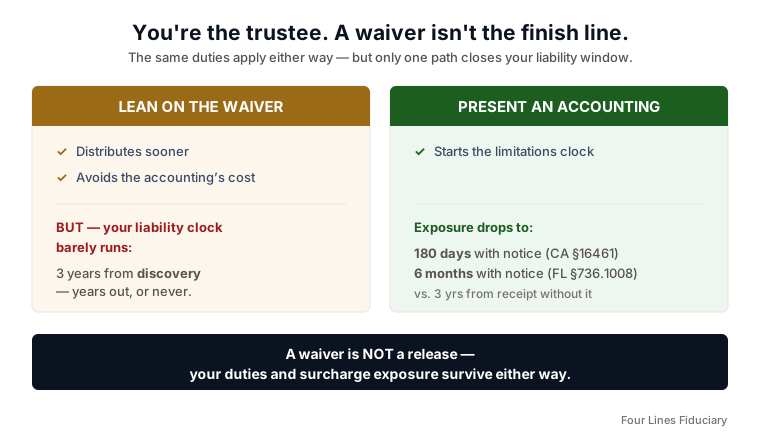
- Presenting an adequately-disclosing accounting starts the limitations clock — and can cut your exposure to as little as 180 days (CA) or 6 months (FL).
- That's the trade most trustees should want: a defined window instead of an open one, off the same record you'd need to defend yourself anyway.
What a waiver does — and what it doesn't
A waiver of accounting is a written agreement in which a beneficiary gives up the right to receive a formal accounting for a period, or for the whole administration. It surfaces at the end, when you're ready to distribute and wind down. Without waivers, you'd first have to prepare a full court-format accounting — in California, the format in Probate Code §1061; in Florida, the format under the probate rules. Collect a signed waiver from every beneficiary and you can skip that step and pay out.
What trips trustees up is the line between two documents that often ride on the same page:
- A waiver declines the accounting — the report of what came in, what went out, and what's left.
- A release discharges you from liability for how you administered the trust.
Waiving the accounting and releasing the trustee are two separate things. A beneficiary can sign the first without signing the second. So can you, by assuming a stack of waivers protects you when not one of them releases a claim.
Watch out — a waiver is not a releaseA signed waiver means you don't have to present a formal accounting. It does not erase your duty to have administered the trust loyally and prudently, and it doesn't, by itself, sign away a beneficiary's right to question what happened. Your exposure to a surcharge survives the missing accounting unless the beneficiary separately and knowingly releases it.
A waiver doesn't excuse the records
Here's the part that's easy to get wrong: the waiver removes the requirement to present an accounting. It removes none of the reasons you needed the records in the first place.
A waiver collected on top of clean books is real protection. A waiver collected over a shoebox of unsorted statements is thin cover that evaporates the moment anyone pushes. If a beneficiary later claims they were misled, or a quiet party surfaces, or a co-trustee turns on you, your defense is a complete, reconstructable record of every dollar — not a signature.
And the waiver does nothing for the tax filing. The trust's fiduciary income-tax return (Form 1041) still comes due, and that return is only as honest as the records under it: income, gains, distributions, and the principal-versus-income split all have to be supported. Skip the accounting and skip the bookkeeping and you'll often reconstruct the whole year anyway — under a filing deadline, the worst possible time to do it. Our explainer on principal vs. income covers why that split matters well past any formal accounting.
The clean way to think about it: a waiver is a decision about whether to present an accounting. It is never a decision about whether to keep the records that stand behind one.
The waivers that won't hold
A waiver only protects you if it holds up. Several common ones don't — and a waiver that fails is worse than none, because it lulls you into closing the file without a real defense.
For a waiver to stick, the basics generally have to be in place:
- Capacity. The signer is an adult of sound mind. A minor or incapacitated beneficiary can't waive on their own — that takes a guardian, a representative, or the court, depending on the state and the instrument.
- Knowing and voluntary. No pressure, no deadline used as a club, no signing in the dark. A waiver from a beneficiary who was never shown a single number is far weaker than one from a beneficiary who reviewed a clear summary first.
- Within the instrument's terms. The trust document can impose its own conditions, so it's always the first read.
The minor-beneficiary trap: virtual representation
Trusts with minor, unborn, or contingent remainder beneficiaries are where trustees most often collect a waiver that won't hold. Under virtual-representation rules, a parent or a beneficiary with a substantially identical interest can sometimes sign a binding waiver on behalf of one of these beneficiaries (Cal. Prob. Code §15804; Fla. Stat. §§736.0303–736.0305) — but only if there's no conflict of interest between them.
That's the catch. If the adult who signs also took a separate personal distribution, served as co-trustee, or holds a different economic stake, the interests diverge and the representation can fail. The waiver is then void as to the minor or contingent interest, and you stay exposed when that interest vests or the beneficiary reaches majority. A waiver that looks complete on paper can leave the exact gap it was meant to close.
The upside you're skipping: an accounting starts the clock
This is the defensive reason to present an accounting rather than lean on a waiver — a proper accounting shortens how long you can be sued.
- No accounting, and the clock barely runs. A beneficiary's claim isn't time-barred until three years after they discovered, or reasonably should have discovered, the problem (Cal. Prob. Code §16460(a)(2)) — which can land years out, or never. A signed waiver doesn't fix this; it declines the report, it doesn't start a clock.
- A written accounting that adequately discloses the facts. Now the beneficiary is barred unless they sue within three years of receiving it (§16460(a)(1)). The clock has a hard start date.
- Shorten the objection window — when the instrument allows it. If the trust instrument provides for a shortened period, California lets you cut the beneficiary's time to object to as little as 180 days (never less), given effect by serving the account with the required 12-point boldface notice (§16461). Absent that, an adequately-disclosing account still bars claims three years after receipt (§16460).
- Florida works the same way. A "trust disclosure document" delivered with a limitation notice cuts the period to six months from receipt; without it, the general four-year clock (running from the beneficiary's actual knowledge) applies (Fla. Stat. §736.1008).
A waiver buys a faster distribution. A clean, adequately-disclosing accounting buys something a waiver can't: it converts an open-ended liability into a short, defined window. That's the trade most trustees should actually want — and it runs on the same complete record you'd need to defend yourself anyway.
Lean on the waiver, or present an accounting?
| If you lean on the waiver | If you present an accounting | |
|---|---|---|
| Speed | Distribution moves now; no court-format accounting first | Wait weeks to months while it's prepared |
| Cost | Avoids the time and fees of a formal accounting | The estate bears the cost of preparing it |
| Your liability clock | Barely runs — a beneficiary has 3 years from discovery (CA §16460(a)(2)), which can be years out or never | An adequately-disclosing account starts the clock: 3 years from receipt (CA §16460) — shortened to as little as 180 days only if the instrument allows and you serve the §16461 notice; FL is 6 months with a §736.1008 limitation notice |
| If the waiver fails | You're exposed with no defense and no clock — worst of both | N/A — the disclosure does the protecting |
| Records you still need | All of them — for the 1041 and any later challenge | All of them — the accounting is the record, organized |
| Best when | Clean books, simple numbers, no minor/contingent interests, full trust | You want the liability window closed, or there's any conflict or complexity |
Common questions
Does a waiver of accounting release me from liability?
No. A waiver declines a document; a release discharges liability. They're separate, and they're often presented in the same paperwork. Unless a beneficiary separately and knowingly signs a release, your fiduciary duties and surcharge exposure survive the waiver.
If every beneficiary waived, do I still need clean records?
Yes — arguably more. The waiver removes the requirement to present an accounting, not the need for records. They're your defense if anything is questioned later, and the 1041 still has to be supported by income, gains, distributions, and the principal-versus-income split.
Can a parent waive on behalf of a minor beneficiary?
Sometimes, under virtual-representation rules (Cal. Prob. Code §15804; Fla. Stat. §§736.0303–736.0305) — but only with no conflict of interest. If the signing adult also took a distribution, served as co-trustee, or holds a different stake, the representation can fail and the waiver is void as to the minor or contingent interest, leaving you exposed when it vests.
Why would I present an accounting if the beneficiaries are willing to waive?
Because it shortens how long you can be sued. An accounting that adequately discloses the facts bars a beneficiary's claim unless they act within three years of receiving it in California (Cal. Prob. Code §16460) — and the trust instrument can shorten that to as little as 180 days when the account carries the required statutory warning (§16461). Florida cuts it to six months with a trust disclosure document and a limitation notice (Fla. Stat. §736.1008). With only a waiver, the clock runs from when the beneficiary discovered the problem — effectively open-ended.
A beneficiary asked to see a summary before signing. Is that a red flag?
No — it's reasonable, and sharing it works in your favor. A waiver signed after the beneficiary reviewed a clear summary is far stronger than one signed in the dark, because it's more clearly knowing and voluntary.
This is general information, not legal or tax advice. Whether a waiver is valid, advisable, or sufficient depends on the trust instrument and the laws of your state, and the rules differ between California and Florida. Confirm specifics with your attorney.
Clean books behind the waiver — or a defensible accounting.
We build a clear, reconstructable record from the source documents, whether you're backing a waiver or presenting an accounting to close the liability window. Free scope, flat fee before you commit. You'll never get a blind quote.