
Estate vs. trust vs. tax vs. GAAP: the four "accountings" a fiduciary confronts
A probate clerk rejects a "trust accounting" filed for an estate that has no trust. A trustee files a Form 1041, exhales, and assumes the court accounting is handled — it isn't. A beneficiary's lawyer demands a "final accounting" from a trustee whose trust runs another fifteen years.
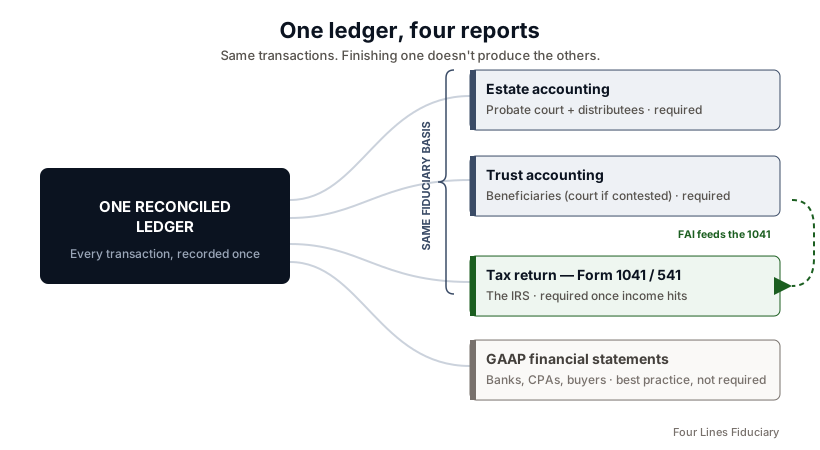
Every one of these mistakes comes from the same place: the word "accounting" gets used for four different documents, and people collapse them into one. They are not one. A fiduciary settling a trust or estate can owe up to four separate reports, built from the same pile of transactions but answering different questions for different readers — and finishing one does not produce the others.
This page is the map: the four "accountings," who reads each, which are mandatory, and the one place they actually connect.
The short version
- Two of the four are the same basis — the fiduciary court accounting — in two flavors: an estate accounting (a personal representative closing probate) and a trust accounting (a trustee, usually for years).
- The tax return (Form 1041 / CA 541) is a different basis entirely: taxable income, for the IRS — not the court's format.
- GAAP financial statements are a third basis: best practice, useful to banks and CPAs, but no trust or estate statute requires them.
- Same transactions, up to four reports. Doing the 1041 doesn't satisfy the court; the court accounting doesn't satisfy the IRS; GAAP satisfies neither.
- The one real link: the court accounting's income figure (fiduciary accounting income) feeds the 1041's income-distribution deduction — so the principal/income split you do for the court is an input to the tax return.
The four at a glance
| Estate accounting | Trust accounting | Tax return (1041 / 541) | GAAP statements | |
|---|---|---|---|---|
| Question it answers | What did the PR do to settle and close the estate? | What did the trustee do with the property? | What did the entity earn, and what tax is owed? | What's the financial position on a standard basis? |
| Basis | Fiduciary: charges = credits, principal/income | Same fiduciary basis | Taxable income (IRC Subchapter J) | GAAP |
| Who reads it | Probate court + distributees | Beneficiaries (court only if contested) | IRS / state tax authority | Banks, institutional trustees, buyers, your CPA |
| Required? | Yes — to close probate | Yes — standing duty to beneficiaries | Yes, once income thresholds are hit | No — best practice, not mandated |
| Format / cite | CA §1060–1064; FL Prob. R. 5.346 | CA §1061–1063 (contents §16063); FL R. 5.346 (§736.08135) | Federal Form 1041 (+ CA Form 541) | Financial-statement standards |
| Principal vs. income | Yes — UFIPA | Yes — UFIPA | Not on the return — but FAI feeds the deduction | Not a GAAP concept |
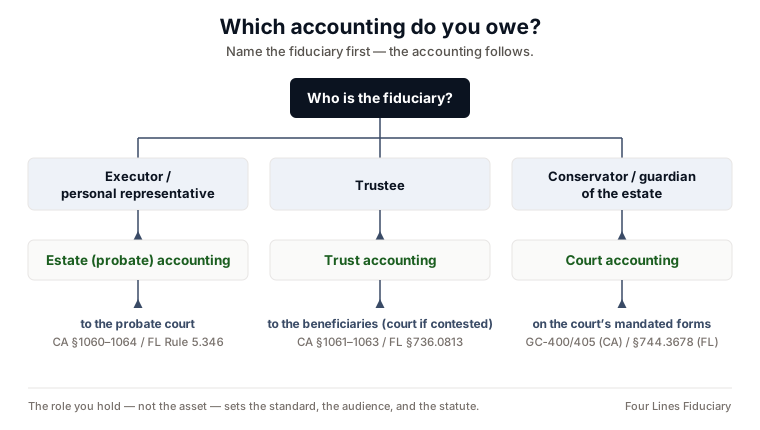
Estate vs. trust: name the fiduciary first
The two court accountings are the same basis, so the way to tell which one you owe is to name the job, not the document.
- Settling a deceased person's probate estate? You're a personal representative — the executor with a will, the administrator without. Your report is an estate accounting: it closes the estate and gets you discharged.
- Holding and managing assets in a trust? You're a trustee. Your report is a trust accounting: it shows beneficiaries what you did with their property — usually more than once over the life of the trust.
- Appointed over a living person or their property? A conservator (CA) or guardian (FL) is a third fiduciary track with its own forms. See conservatorship and guardianship accountings.
An estate accounting closes something out; a trust accounting reports on something still running. Finite job vs. ongoing one — that single difference drives the timing and the audience.
An estate accounting is a gate. The PR accounts to the probate court, the court approves, and then the assets pass — account first, distribute second. Heirs can sometimes waive the formal account (California: Prob. Code §10954), but a waiver removes the account, not the work: the records still have to be assembled and balanced, and in California the representative still files a final report of administration. See estate accounting for the final-distribution petition.
A trust accounting is a standing duty — and it doesn't wait for a judge. Most trusts are never court-supervised, yet the trustee still owes accountings directly to beneficiaries by statute (CA §16062; FL §736.0813). A beneficiary entitled to one can demand it; the court is the backstop if the trustee refuses, not a precondition. Two consequences:
- Keep the books ready — not "reconstructable later." Because the account can be demanded anytime, the trustee has an affirmative duty to keep clear, accurate records as the administration runs (Florida makes it explicit in §736.0810; it's black-letter trust law everywhere).
- Gaps fall on you. A trustee who can't show where the money went is in breach, and the law resolves the doubt against the trustee — a classic route to a surcharge, a court order to repay the trust from your own pocket. (What a trustee surcharge is →)
The tax return is a different question
The 1041 trips people up because it feels like "the accounting" — it has numbers, it's official, it's due on a calendar. But it answers a different question (what was earned and what tax is owed) for a different reader (the IRS), on a different basis (taxable income under Subchapter J).
- When it's required. An estate or trust must file Form 1041 if it has gross income of $600 or more, any taxable income, or a nonresident-alien beneficiary — that last one regardless of dollar amount. California adds Form 541. The fiduciary issues each beneficiary a Schedule K-1 for the income passed through to them.
- Why it isn't the accounting. Taxable income groups transactions by tax character — ordinary income, capital gain, deductible expense. The court accounting groups them by whose money it is — principal vs. income — and by where each sits in the charges-and-credits balance. Same raw data, incompatible structures. A capital gain is taxable income on the 1041 and principal on the accounting, at the same time.
Your CPA owns the 1041. A fiduciary-accounting specialist owns the court accounting — and the two work together. (See can my CPA do a trust accounting?)
GAAP: useful, not required
The third basis is the one nobody is forcing on you. GAAP financial statements present the entity's position on the standard basis a bank, an institutional trustee, or a buyer in diligence expects. They're genuinely useful for clarity — but:
Hint — GAAP is best practice, not a mandate.No trust, estate, or probate statute requires GAAP financial statements. Institutional trustees keep them for governance; most individual fiduciaries don't need a formal GAAP statement at all. What everyone does need is one clean, reconciled ledger underneath — the thing all four reports are actually built from.
"Fiduciary accounting income" is its own creature, defined by the instrument and UFIPA. It equals neither GAAP income nor taxable income — which is exactly why treating any one of the four reports as a stand-in for another is where things fall apart.
Same math under estate and trust — and the one link to tax
Whatever the format on top, both court accountings rest on one identity: total charges = total credits, to the dollar. Property on hand at the start, plus everything received, plus gains, must equal disbursements, losses, distributions, and property on hand at the end. The proving schedules — receipts, disbursements, gains and losses, distributions, property on hand — look the same in an estate and a trust; only the court wrapper changes (CA §1060–1064 vs. §1061–1063; in Florida, the single Rule 5.346). See California vs. Florida court accounting format.
And the principal/income split runs through both, because UFIPA defines "fiduciary" to include a personal representative and a trustee (CA Prob. Code §16320 et seq., eff. 1/1/2024; FL Chapter 738, eff. 1/1/2025). An estate allocates between principal and income just like a trust — there are simply fewer questions over a short administration. (Principal vs. income →)
Here's the connection most people miss. The four reports are separate, but they aren't sealed off from each other:
The court accounting feeds the 1041.Federal tax law (IRC §643(b); Reg. §1.643(b)-1) defines "income" for trust-tax purposes as fiduciary accounting income — the very principal/income figure your court accounting produces. Before the 1041 can be prepared, the fiduciary has to compute that accounting income, because the income-distribution deduction (capped by distributable net income) depends in part on it. Get the principal/income split wrong on the accounting and you can misstate the deduction on the return. The court accounting isn't a substitute for the 1041 — it's an input to it.
That's the practical case for getting the accounting right first: it's the document the court and beneficiaries judge you on and the source your CPA's return draws from.
FAQ
Is an estate accounting the same as a trust accounting?
No — but they're the same basis. An estate accounting is filed by a personal representative to close probate, usually with the petition for final distribution. A trust accounting is filed by a trustee to the trust's beneficiaries, typically more than once. Different fiduciary, audience, and timing; identical charges-and-credits, principal/income math.
Does filing the Form 1041 satisfy the court accounting?
No. The 1041 reports taxable income to the IRS; the court accounting reports your stewardship to the court and beneficiaries in a statutory format. Different question, reader, and basis — finishing one doesn't produce the other.
Does GAAP or the tax return replace the court accounting?
No. The fiduciary accounting is its own basis — not GAAP, not the 1041. A trust or estate may keep all four sets of records, but each is a separate work product.
Can either court accounting be waived?
Sometimes. California heirs can waive the estate account (Prob. Code §10954), though the PR still files a final report. A trust accounting can be waived in writing by a beneficiary, and the instrument can limit it (CA §16064; FL §736.0813(2)) — with exceptions (e.g., the duty generally doesn't run to remainder beneficiaries of a revocable trust while the settlor lives). Either way, the records still have to be reconstructed and balanced. A waiver isn't a release →
Can the same person owe more than one of these?
Routinely. Someone serving as executor of an estate and trustee of the trust it pours into owes an estate accounting and a trust accounting — plus a 1041 for each entity once income thresholds hit. Three or four reports, one person, same underlying records.
This is general information, not legal or tax advice, and not an attorney or CPA engagement. Which accounting applies, what format it must follow, who is entitled to it, and whether it can be waived all depend on your state, your court, and the governing instrument. Confirm specifics with your own attorney and CPA.
Not sure which of the four you owe?
Bring us the records. We'll tell you what's required, reconstruct the ledger, and deliver it court-ready — for an estate's final-distribution petition or a trustee's account — and hand your CPA clean, reconciled, 1041-ready books underneath. Flat fee, fixed before you commit, never a blind quote.