
UFIPA, explained: the one question that decides who gets paid from a trust
Every dollar that moves through a trust is either principal or income — and in most trusts those two buckets are owed to two different people. UFIPA is the rulebook that decides which is which, line by line. Here's what it is, what it replaced, and why getting it wrong is what surcharge claims are built on.
A trust pays a $40,000 distribution out of a partnership. Was that income — owed to the surviving spouse who takes the trust's earnings for life — or was it a return of capital, which belongs to the kids who inherit the principal when she dies? Get it wrong and you've paid the wrong person with someone else's money. UFIPA is the rulebook that answers that question, dollar by dollar, for every receipt and disbursement that moves through a trust or estate.
It's the part of an accounting beneficiaries actually fight over, and the part a trustee personally answers for. Pay the wrong person and you've breached the duty of impartiality — the kind of error that draws a surcharge claim against you personally.
The short version
- UFIPA = the Uniform Fiduciary Income and Principal Act. It tells a fiduciary whether each dollar is principal or income — which decides who it's owed to.
- When it applies: in every accounting you're required to render for a trust or estate with separate income and remainder interests. The split is built into the accounting's content (CA §16063 / FL §736.08135) — not an optional add-on. When an accounting is required →
- It replaced the older Uniform Principal and Income Act (UPIA), modernized for total-return investing, retirement accounts, and unitrusts.
- Its defaults yield to the trust document, and it gives the trustee a power to adjust (and a unitrust option) when the defaults would be unfair.
- California: Prob. Code §16320 et seq., effective 1/1/2024 (SB 522). Florida: Fla. Stat. Ch. 738, effective 1/1/2025.
- A multi-year accounting that straddles the effective date is governed act-by-act, transaction by transaction — not with one blanket rule.
What UFIPA is: an allocation rulebook, not a tax code
UFIPA is a model law from the Uniform Law Commission that each state enacts on its own. It does one job: it allocates receipts and disbursements between principal and income. That sounds narrow. It isn't, because in a great many trusts the two buckets are paid to two different people.
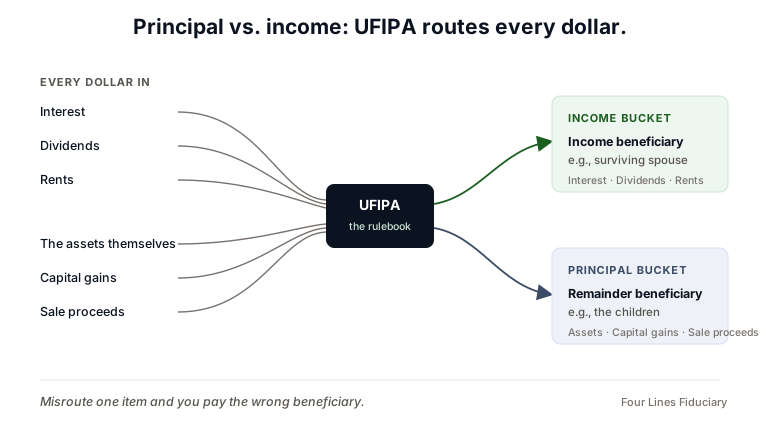
- An income beneficiary is entitled to what the trust earns — interest, dividends, rent — often for life.
- A remainder beneficiary takes what's left, the principal (corpus), when the trust ends.
- Classic setup: a surviving spouse takes income for life; the children take principal at her death.
Every dollar that flows through the trust has to land in the right bucket, because the two buckets have different owners. Call a capital gain "income" and the life tenant pockets what the remaindermen were owed. Call interest "principal" and you starve the income beneficiary. UFIPA is the framework that decides each call — and its defaults yield to the trust instrument, filling the gaps wherever the document is silent. For the deeper treatment of where this line gets genuinely hard, see principal vs. income in a trust accounting.
One thing UFIPA is not: a tax rule. A capital gain is principal for accounting (it belongs to the remaindermen), even though the same gain is taxable income on the trust's Form 1041. The two systems answer different questions and routinely disagree, so the tax return is the wrong place to source a court accounting.
What it replaced: the older principal-and-income framework
UFIPA is the successor to a long line of principal-and-income statutes, most recently the Uniform Principal and Income Act (UPIA). That older framework did the same sorting job, but it was built for a world of stock-and-bond portfolios where "income" — the dividends and interest — roughly tracked what a life beneficiary should reasonably receive.
Modern investing broke that assumption:
- Total-return investing chases growth, not yield. A portfolio can perform beautifully and throw off almost no "income," starving the life beneficiary while the remaindermen's principal swells.
- Retirement and deferred-comp accounts (IRAs, pensions, annuities) don't expose their internal income cleanly.
- Unitrust conversions — paying a fixed percentage of value instead of "income" — needed a real statutory home.
UFIPA modernizes the framework to handle all three. It formalizes the power to adjust and unitrust conversion so a trustee can keep allocations fair under a total-return approach, and it rewrites the receipt-by-receipt defaults. When a state adopts UFIPA, it generally repeals the prior act — which is exactly why the effective date matters for older, catch-up accountings.
The core mechanics: how a receipt or disbursement gets allocated
Start with the rule of thumb, then learn where it breaks. Income is what an asset produces. Principal is the asset itself and any change in its value. The common items map cleanly; the money is in the exceptions.
| Common item | Principal or income | Why (and the CA section) |
|---|---|---|
| Interest on a bond or note | Income | It's what the asset produces. Sale or redemption of the bond is principal. (§16345) |
| Cash dividend / cash distribution from an entity | Income | A normal payout of earnings. (§16340) |
| Rent | Income | Produced by the property. A security deposit stays principal until obligations against it are satisfied. (§16344) |
| In-kind distribution, return of capital, partial liquidation, RIC/REIT capital-gain dividend | Principal | The entity is handing back the asset, not its earnings. (§16340) |
| Sale proceeds / capital gain on a principal asset | Principal | A change in the asset's value, not a product of it. (§16343) |
| Eminent-domain proceeds | Principal | Compensation for the asset itself (except a mandatory-income-loss award). (§16343) |
| IRA / pension / annuity payout | Split | Income = the fund's internal income (deemed 4% if undeterminable); the rest is principal. (§16348) |
| Wasting / liquidating asset (royalty, leasehold, patent) | Mostly principal | Income capped at 4% of value; the balance is principal, since the asset is being consumed. (§16349) |
| Regular trustee / advisor / custodian fee | Split 50/50 | Half charged to income, half to principal. (§16360 + §16361) |
| Acceptance, distribution, or termination fees | 100% principal | One-time charges fall entirely on principal. (§16361) |
| Estate / inheritance tax; extraordinary repairs; capital improvements | Principal | Costs that benefit or burden the corpus. (§16361) |
(CA section numbers are California's enactment, Prob. Code §16320 et seq. Florida's equivalents live in Fla. Stat. Ch. 738.)
The pattern underneath: a product of the asset is income; a change in the asset itself, or a one-time/extraordinary event, is principal. The hard items — entity distributions, retirement accounts, wasting assets, bond premium and discount — are the ones that don't announce which they are, and they're where misallocations hide.
The escape hatches: the power to adjust and the unitrust
UFIPA knows its own defaults can produce an unfair result, so it builds in two relief valves.
- The power to adjust (CA §16327; FL §738.203). When the mechanical split would shortchange the income or the remainder side — the classic total-return squeeze, where a growth portfolio produces almost no accounting income — the trustee can shift dollars between principal and income to restore fairness. It's exercised in a record, without court approval, subject to a list of prohibitions and a notice requirement. A constrained, documented judgment call — not a free hand to favor one beneficiary.
- Unitrust conversion (CA §§16330–16338; FL §§738.301–738.310). Instead of chasing "income," the trustee converts to paying a fixed percentage of the trust's value each year — a 3–5% rate in both states (4% is the common default; CA §16336.4, FL §738.306). That decouples the life beneficiary's payout from how the portfolio happens to be invested, so the trustee can invest for total return without starving anyone. Conversion runs through a plan-and-notice process and, like the power to adjust, doesn't require a court order in the ordinary case.
There's also a dedicated section for the narrow, recurring problem of marital-deduction property that produces little or no income (CA §16352): the mandatory-income spouse can compel the trustee to make the property productive, convert to a unitrust, or use the §16327 adjustment. For general (non-marital) underproductivity, the lever is the §16327 power to adjust read against the statute's impartiality factors.
Why not just index the principal to inflation?
A reasonable trustee with a finance background asks the obvious question: why not skip the buckets entirely, peg principal to a real-return hurdle, and pay the income beneficiary everything above inflation? Economically that's Hicksian income — Sir John Hicks's classic definition of income as the most you can consume in a period and end it as well off as you started. The logic is sound. As a way to run a trust, it will get you surcharged.
UFIPA's drafters rejected pure CPI-pegging for three operational reasons, then built a safe harbor that reaches the same goal:
- Tax drag breaks the math. Realizing gains to fund a "real return" distribution triggers capital-gains tax, and that tax is charged to principal. Pay out the excess and pay the IRS, and the corpus lands below its inflation hurdle anyway — the act of distributing shrank the real base it was meant to protect.
- Downside asymmetry starves the income beneficiary. In a year like 2022 (≈8% inflation, S&P down ≈18%), a real-return trust owes the income beneficiary nothing — and may owe nothing for years afterward while the portfolio claws back to its inflation-adjusted high-water mark. A choppy decade can mean a life beneficiary the grantor meant to feed going years without a dollar.
- "Which index?" turns into a fee fight. Audit a trustee who indexed a mixed portfolio against CPI-U and a remainderman's economist will argue for the Chained PCE deflator instead — and tens of thousands in trust cash burns down litigating a 40-basis-point spread.
So UFIPA standardized the goal into the total-return unitrust: pay a fixed ~3–5% of a multi-year average of fair market value (commonly a rolling three-year average), and the principal/income line stops mattering for the payout.
| Accounting model | How "distributable income" is defined | The practical reality |
|---|---|---|
| Traditional / default | Only the "fruit" — dividends and interest | Pushes the trustee toward high-yield, low-growth holdings just to keep the income beneficiary paid |
| Pure "real return" | Total return minus inflation | Logically clean; an administrative and audit nightmare to defend |
| Statutory unitrust (TRU) | Fixed ~4% of a multi-year average FMV | The compromise: equity-like growth for the income beneficiary, ~2–3% real growth left in the corpus, and market crashes smoothed out |
Practitioner's rule of thumb Sitting on a pile of realized-gain cash you'd like to pay to the income beneficiary? Don't invent your own math. The law treats unauthorized methodology as a breach, however elegant your spreadsheet. Two bulletproof routes: (1) the light touch — invoke the power to adjust, point to the portfolio's low dividend yield, and move a fixed dollar amount from principal cash to income cash in a record; or (2) the permanent fix — adopt the unitrust, peg the payout near 4%, and stop running a principal-vs-income ledger at all.
Adoption and effective dates: California and Florida
UFIPA is now law in a number of states (the exact roster keeps growing — confirm your own state before relying on it). The two that matter most for our work:
- California enacted UFIPA as Probate Code §16320 et seq., effective January 1, 2024 (SB 522), repealing the prior Uniform Principal and Income Act. California kept several specific defaults in the statute — the §16348 deemed 4% internal income for retirement accounts, the §16349 4% cap on a wasting asset, the §16327 power to adjust, and §§16330–16338 unitrust conversion.
- Florida enacted its version as the Florida Uniform Fiduciary Income and Principal Act, Fla. Stat. Chapter 738, effective January 1, 2025 — a full year after California, under the same uniform framework but with its own provisions and its own court-accounting format.
So both states now draw the principal/income line under UFIPA, but on different timelines and into different court formats. We cover the format split in California vs. Florida court accounting formats.
The straddle trapAn accounting that spans a UFIPA effective date is governed act-by-act, transaction by transaction — not by the period as a whole. In California, activity before 1/1/2024 falls under the repealed prior act; activity on or after falls under UFIPA. (California keys this to the trust "existing or created on or after 1/1/2024" — a non-uniform twist worth confirming.) Florida's boundary is 1/1/2025. A multi-year catch-up gets split at the boundary date and allocated under whichever act governs each transaction. One blanket treatment for the whole period is how delinquent accountings get bounced.
What this means for you as a trustee
You don't have to memorize the statute. You do have to get the allocations right when you present a court accounting, because that's the line-by-line work a shorted beneficiary scrutinizes and objects to — and the work that protects you if they do.
- Sort every receipt and disbursement into principal or income using the defaults above, deferring to the trust instrument wherever it speaks.
- Watch the hard items — entity distributions, retirement accounts, wasting assets, the trustee-fee split. They don't announce which bucket they belong in.
- Reach for the power to adjust or a unitrust when the mechanical answer is plainly unfair to one side — and document it.
- If your accounting straddles 1/1/2024 (CA) or 1/1/2025 (FL), split it at the boundary and apply each act to its own transactions.
HintThe accounting balancing (total charges = total credits) does not prove the principal/income split is right. A misallocation can tie out to the penny and still pay the wrong beneficiary, which is precisely what a surcharge claim is built on. The split is a separate check from the math.
Reconstructing years of records and applying these rules line by line is exactly the work we do. If you're catching up on overdue filings, start with our guide on being behind on a trust or estate accounting.
Common questions
What does UFIPA stand for?
The Uniform Fiduciary Income and Principal Act — a model law that tells a trustee or executor whether each dollar in a trust or estate is principal or income, which decides who it's owed to.
What did UFIPA replace?
The older Uniform Principal and Income Act (UPIA). UFIPA modernizes it for total-return investing, retirement and deferred-comp accounts, and unitrust conversions, and most states repeal the prior act when they adopt UFIPA.
Is a capital gain principal or income under UFIPA?
Principal. A gain is a change in the value of the asset itself, not something it produced, so it belongs to the remainder beneficiaries. Note this differs from the income-tax treatment of the same gain.
When did UFIPA take effect in California and Florida?
California: Probate Code §16320 et seq., effective January 1, 2024 (SB 522). Florida: Fla. Stat. Chapter 738, effective January 1, 2025. An accounting spanning either date is governed act-by-act, depending on when each transaction occurred.
What is the trustee's power to adjust?
A discretionary power (CA §16327) to shift amounts between principal and income when the default allocation would treat the income and remainder beneficiaries unfairly. It comes with conditions and notice requirements — not a free hand to favor one side.
This is general information about the Uniform Fiduciary Income and Principal Act, not legal or tax advice, and not an attorney or CPA engagement. Statutes and citations change, and allocation outcomes depend on the trust instrument and the specific facts. Confirm the applicable rules and how they apply to your situation with your attorney.
We love messy data.
Send us the box of statements, the half-finished spreadsheet, the years you've fallen behind — whatever shape it's in. We'll reconstruct the ledger, separate principal from income under UFIPA, and deliver a court-ready accounting in your state's format. Flat fee, quoted up front — never a blind quote.