
Supercharge your CPA on trust accounting — hand them court-ready books
You've been named executor or trustee. A beneficiary's lawyer, or the probate court, wants an accounting. So you call your CPA — the person who's filed your returns for fifteen years and knows your numbers cold.
Good instinct. Keep them. But hand them the right raw materials.
A fiduciary court accounting isn't another tax return. It's a separate deliverable, governed by a body of law — principal-and-income allocation, a charges-equal-credits court format, statutory schedules — that a general tax practice has no reason to touch. Not because your CPA isn't sharp. Because it's a different animal, and nobody should be learning it for the first time on your matter, on a court clock, while a beneficiary's attorney reads every line.
That's the job we do. We reconstruct the books, allocate every dollar, and put it in the format the court accepts — then hand your CPA a clean, reconciled, 1041-ready package to review and file from. Your CPA stays in the picture doing what they're best at. They review instead of research. You don't pay anyone to learn on the clock.
The short version
- Your CPA owns the tax side — Form 1041, CA Form 541, the year-to-year books. Keep them there.
- A court accounting is a different deliverable: it reports what you did with the property, in a court-dictated format, balanced to the penny.
- It requires a principal-vs-income split under UFIPA — a step that doesn't exist in tax or bookkeeping.
- We hand your CPA the raw materials: clean books, reconciled, allocated, court-format, 1041-ready.
- The win for everyone: your CPA reviews instead of researches, their risk drops, and you skip the open-ended learning-curve bill.
Your CPA is great — at a different deliverable
The most common mix-up: that a trust accounting is just one more tax filing. It isn't, and finishing one does nothing to produce the other. They answer different questions for different readers.
A fiduciary income-tax return — federal Form 1041, or California Form 541 — reports the entity's income to the taxing authorities. One question: what did the trust or estate earn, and what tax is owed? Your CPA files this in their sleep.
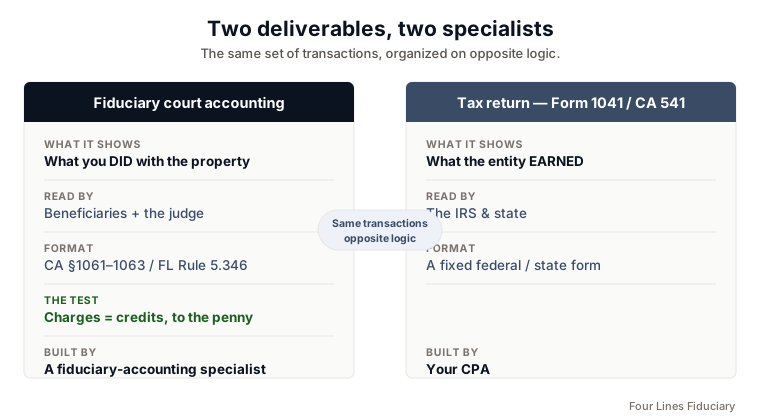
A court accounting answers a different question: what did you, the fiduciary, do with the property? It tracks every dollar in, out, gained, lost, and distributed, and presents it in the format the court accepts. The tax return doesn't generate it, and the two draw on the same transactions but organize them on opposite logic — the return groups by tax character, the accounting groups by who the money belongs to.
| Fiduciary court accounting | Fiduciary tax return (1041 / 541) | |
|---|---|---|
| What it is | Formal report of the fiduciary's stewardship of the property | Income-tax filing for the trust or estate |
| Question it answers | What did you do with the property? | What did the entity earn, and what tax is owed? |
| Who reads it | Beneficiaries; the probate judge in a supervised or contested matter | The IRS and state tax authority |
| Format | Statutory court schedules — CA Prob. Code §1061–1063; Fla. Prob. R. 5.346; charges must equal credits to the penny | IRS Form 1041 / FTB Form 541 — fixed federal/state forms and instructions |
| Principal vs. income | Required; every item allocated under UFIPA | Not the point of the return |
| Whose lane | A fiduciary-accounting specialist (us) | Your CPA |
What makes it a different animal: principal vs. income
Here's the requirement that genuinely sets fiduciary accounting apart from the rest of accounting — the split between principal and income. It's not harder math. It's a different rulebook.
Many trusts pay two groups with opposing interests:
- an income beneficiary, entitled to what the trust earns — often a surviving spouse, for life;
- a remainder beneficiary, entitled to the principal afterward — often the children.
Because those two groups are paid from two different buckets, every transaction has to land in the right one. The errors run both ways:
- Call a capital gain "income" and you hand the life tenant money the remaindermen were owed.
- Call interest "principal" and you shortchange the income beneficiary.
And here's the trap that catches a tax brain: the categories don't match the return. A capital gain is taxable income on the 1041. In the accounting, that same gain is principal — a change in the value of the asset, not a product of it. Booked correctly for tax, routed to the wrong beneficiary for the accounting. Both true at once. Sorting that out isn't a CPA's job, and it isn't a knock on them that it's ours.
This allocation is governed by the Uniform Fiduciary Income and Principal Act (UFIPA):
- California — Probate Code §16320 et seq., effective January 1, 2024.
- Florida — Fla. Stat. Chapter 738, effective January 1, 2025.
UFIPA sets default treatments for the genuinely hard items: entity distributions that may be income or return of capital, trustee fees split between the two buckets, bond premium and discount, wasting assets, and the trustee's power to adjust between principal and income to treat the beneficiaries fairly. (We go deeper in principal vs. income, explained.)
HintThe effective dates do real work. An accounting that spans 1/1/2024 in California (or 1/1/2025 in Florida) can apply both the old and the new principal-and-income rules, depending on when each transaction occurred. A blanket treatment across the whole period is wrong on its face. One more reason multi-year catch-ups need transaction-level handling — and one more thing your CPA shouldn't have to reverse-engineer.
The raw materials we hand your CPA
This is the core of how we work with your accountant, not around them. We do the part that lives outside their practice and hand back something they can use immediately:
- Reconstructed transaction history from whatever you have — a box of statements, a QuickBooks export, years of mess.
- Principal and income separated line by line under UFIPA.
- A court-format accounting in the schedule your jurisdiction accepts (CA Prob. Code §1061–1063 or Fla. Prob. R. 5.346), with charges balanced to credits to the penny.
- Clean, reconciled, 1041-ready books and workpapers your CPA files straight from.
ExampleWhat the handoff looks like: you bring three years of brokerage statements and a shoebox. We build the accounting, tie out the balance, and tag every transaction principal-vs-income. Your CPA opens a reconciled workbook where the income lines are already separated, picks up the 1041, and files. No reverse-engineering, no "can you re-pull the cost basis," no learning curve billed to you.
The books we hand back make the 1041 easier. The two roles complement each other — your CPA keeps the tax work, the planning, the relationship; we keep the court format and the allocation.
A court format general software won't print
Even a skilled accountant in QuickBooks hits a wall here, and it isn't a skill gap — it's a tooling gap. General accounting software has no concept of principal-versus-income allocation, and it can't output a court format: not a CA Prob. Code §1061–1063 summary and schedules, not the GC-400/405 conservatorship forms, not a Fla. Prob. R. 5.346 accounting. Conservatorships and guardianships add their own layer; Florida requires an annual guardianship accounting under Fla. Stat. §744.3678. (See the conservatorship and guardianship accountings overview.)
Without a specialist, the workaround becomes: keep books in QuickBooks, export to Excel, and hand-build the schedules at 11pm before a deadline. Slow, error-prone, and most fragile exactly when a beneficiary or judge is reading closely. We replace that scramble with a finished schedule.
The second calendar — one we watch alongside your CPA
Your CPA tracks the tax-filing calendar. A fiduciary runs on a second one — the court's — with filings that have nothing to do with April 15, and missing one is your exposure. We watch that calendar so it doesn't fall between the two of you: the inventory, the periodic accountings, and the deadline to close, each a default a court order or the instrument can shorten.
See the full California & Florida probate deadline chart →
Why this protects your CPA, too
Handing the court accounting to a specialist isn't only about your wallet. It lowers the risk on everyone's side of the table:
- Your CPA reviews instead of researches. Reviewing a reconciled, court-format workbook is squarely in their competence. Building one from scratch — in a format their software doesn't print, under a statute they don't practice — isn't, and a half-learned accounting still draws the objection.
- Your exposure drops. A court accounting that shorts a beneficiary invites an objection, and the fiduciary answers for it personally. A surcharge is a court order that you make the trust whole out of your own pocket. (See what a trustee surcharge is.) Done right the first time, that risk goes away.
- No open-ended learning-curve bill. Nobody bills you by the hour to learn fiduciary accounting on your matter. We quote a flat fee for a known deliverable.
Watch outBalancing is the test, not the formatting. If the two columns don't tie to the penny, you don't have an accounting yet — you have a draft a beneficiary's attorney will pull apart. The balance is the proof that every dollar is accounted for, and it's the first thing they check. That's the line we deliver finished, so your CPA never has to.
FAQ
Can my CPA do my trust accounting?
They can file the 1041 and keep the year-to-year books — that's their lane, and they're good at it. A court accounting is a separate deliverable in a statutory format (CA §1061–1063 / Fla. R. 5.346) with a principal-vs-income split most general practices never touch. Most CPAs are best kept on the tax side while a specialist builds the court accounting and hands them ready books.
Do I have to fire my accountant to hire you?
No — the opposite. We work alongside your CPA. We do the court accounting and the principal/income allocation; they do the 1041, the 541, and the planning. The books we hand back make their filing easier.
Isn't a trust accounting just a P&L for the trust?
No. A P&L sits on a single net-worth axis. A court accounting is a charges-equal-credits reconciliation — property on hand plus receipts and gains must equal disbursements, losses, distributions, and property on hand at the end, to the penny — with supporting schedules behind every line.
Why can't QuickBooks just print it?
General accounting software has no concept of principal-versus-income allocation and can't output a court format (§1061–1063, GC-400/405, or Rule 5.346). The usual workaround is exporting to Excel and hand-building schedules — slow and error-prone exactly when it's read most closely.
My matter spans the new UFIPA effective date. Does that matter?
Yes. An accounting crossing 1/1/2024 in California or 1/1/2025 in Florida may apply both the old and new principal-and-income rules, transaction by transaction. A blanket treatment across the whole period is wrong on its face — it needs transaction-level handling.
This is general information, not legal or tax advice, and not an attorney or CPA engagement. Requirements vary by court and by the trust instrument; confirm specifics with your attorney or CPA.
Scope it before you commit a dollar.
Send us what you've got and we'll quote a flat fee — what your accounting needs to include, what it will cost, and how long it will take, up front and in writing. Already past a deadline? Start with behind on a trust or estate accounting.