
Carry value vs. market value: how assets are valued in a trust or estate accounting
The brokerage statement says the account is worth $312,000 today. Your accounting still shows it at $280,000. Nothing is wrong. A court accounting and a brokerage statement answer two different questions, and the number that belongs on the accounting is almost never the one printed on this month's statement.
That gap confuses nearly every first-time trustee and executor. Here's the rule it runs on, why the rule exists, and where valuation actually gets hard.
The short version
- A fiduciary accounting carries each asset at its carry value — a fixed number set when the asset entered the accounting — not at today's market price.
- For estates and trusts that fund at death, that opening carry value is usually the fair market value on the date of death. It then stays put.
- The accounting reports stewardship, not market mood. So paper gains don't show; the gain or loss only appears when the asset is sold.
- The hard part is assets with no quoted price: real property, closely-held business interests, art, notes. Each needs a documented, defensible number.
- Realized gain or loss on the accounting is an allocation question (generally principal). It is not the taxable gain on the trust's income-tax return.
Carry value vs. market value: two numbers, two jobs
Carry value is the value at which an asset entered the accounting, and it is held fixed from that point forward. Market value is what the asset would fetch if sold today, and it moves every time the market moves.
The accounting runs on carry value for a structural reason. A court accounting has to balance: total charges equal total credits, to the dollar (see what a trust accounting is). That balance only holds if the opening figures stay anchored. Let carry values float with the market and the columns stop tying out, because you'd be crediting the fiduciary for gains nobody realized and no schedule can prove.
| Carry value | Fair market value | |
|---|---|---|
| What it answers | What did the fiduciary start with, and what's been done with it? | What is this asset worth right now? |
| Behavior over time | Fixed when the asset enters the accounting | Changes with the market, daily |
| Where it's used | The body of the accounting: summary, schedules, the balance | The property-on-hand schedule, shown alongside carry value where required |
| Set by | Date-of-death FMV (or cost, for assets the fiduciary buys) | The market, an appraisal, or the eventual sale price |
| Drives | The gain or loss measured at sale | Estate-tax reporting; informing beneficiaries; investment decisions |
Both numbers matter. They just live in different places. The accounting body runs on carry value; current market value rides alongside the property-on-hand schedule as supplemental information, not folded into the running totals.
Date-of-death valuation: the day that anchors everything
For an estate, and for a trust that funds at death, the reference date is usually the date of death. Every asset is valued as of that one day, and those values become the opening carry values for the entire accounting.
This is why so much early work on an estate is valuation work. You're pinning down, as of a single date:
- Account balances — bank, brokerage, retirement, as of the date of death.
- Real property — a qualified appraisal as of that date.
- Anything unique — business interests, art, collectibles, notes receivable.
That date-of-death figure does double duty. It sets the carry value the accounting uses going forward, and it's the baseline that the eventual gain or loss is measured against when the asset is sold. Get it wrong at the outset and every downstream number inherits the error.
Watch outA date-of-death appraisal isn't a formality you can skip and backfill. For estate-tax basis and for the accounting's gain/loss math, the value has to be fixed as of that date. Months later, a defensible number is far harder to reconstruct. An alternate valuation date — six months after death — may apply for federal estate-tax purposes (IRC §2032), but only if the executor elects it on the Form 706 and it lowers both the gross estate and the estate tax. That's a tax-return election for the CPA, separate from the accounting's carry value.
Why the accounting ignores market swings
It would seem more "accurate" to revalue everything to current market value each period. A court accounting deliberately doesn't, and the reason is the whole purpose of the document.
The accounting is a record of stewardship: what came in, what went out, what the fiduciary did. If carry values floated up and down with the market, the report would blur two unrelated things — the fiduciary's actual decisions and the market's mood. A stock that simply sat in the account and rose 18% reflects nothing the fiduciary did. Crediting that paper gain to the accounting would reward the fiduciary for the weather.
So unrealized gains don't appear in the body of the accounting. The asset holds at carry value until something actually happens to it. Current market value often does appear, but as a supplemental column next to property on hand, so a beneficiary can see today's worth without it contaminating the balance.
How gains and losses show up at sale
Selling the asset is the moment the number moves. The difference between the sale proceeds and the asset's carry value becomes a realized gain or loss, and that's when it enters the accounting.
- Sell an asset carried at $200,000 for $250,000, and the $50,000 gain lands on the gains-on-sales schedule (charges side).
- Sell it for $180,000, and the $20,000 loss lands on the losses schedule (credits side).
One subtlety that trips people up: the sale proceeds aren't booked again as a receipt. Only the gain or loss flows through. Double-counting the proceeds is a classic way to blow the balance.
A worked example (hypothetical)
The figures below are illustrative only — not from any real matter, and rounded to keep the structure clear.
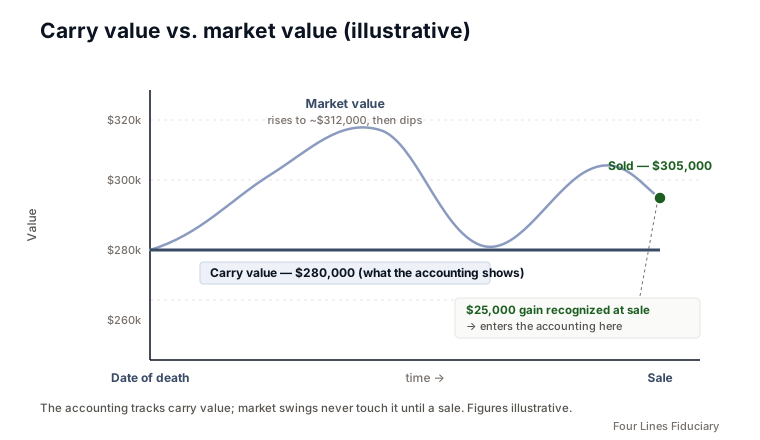
A trust funds at death holding 1,000 shares of Example Co. On the date of death, the shares are worth $280 each = $280,000. That becomes the carry value.
Over the next two years, the position drifts up and down; at one point a statement shows it at $312,000. The accounting does not change — it still carries the shares at $280,000 the whole time. No gain is recorded, because nothing has been realized.
In year three, the trustee sells all 1,000 shares for $305,000.
| Asset | Carry value (date of death) | Sale price | Gain / (loss) |
|---|---|---|---|
| 1,000 sh. Example Co. | $280,000 | $305,000 | $25,000 gain |
What happens on the accounting:
- The $25,000 gain appears on the gains-on-sales schedule and flows to the charges side of the summary.
- The carry value drops out of property on hand; cash of $305,000 takes its place.
- The intermediate $312,000 statement value never appears anywhere. It was never realized, so the accounting never saw it.
That $25,000 is an accounting gain, allocated under the principal-and-income rules (UFIPA — Cal. Prob. Code §16320 et seq.; Fla. Stat. Ch. 738), generally to principal. It is not necessarily the taxable gain on the trust's income-tax return (federal Form 1041 / California Form 541). Tax basis can differ from accounting carry value, and the two are computed for different audiences. Treat them as separate calculations.
HintWhen carry value equals date-of-death FMV (the usual case for inherited assets), accounting gain and taxable gain often start from the same anchor — the stepped-up basis. They can still diverge over time. Don't assume one number serves both the court and the IRS.
Why that $25,000 gain is principal, not income
The gain feels like profit, and profit feels like income. That instinct is corporate-finance logic, and a trust isn't a corporation. In corporate accounting a dollar is a dollar: realize a profit, it hits the bottom line and can go out as a dividend. Fiduciary accounting treats a dollar as a container — and the gain lands in the principal container for two reasons worth understanding, because the same logic drives half the allocation calls you'll ever make.
The asset is sliced across time
A corporation's shareholders own 100% of the present and 100% of the future. A trust splits a single asset horizontally, across time:
- the income beneficiary owns the present — the right to be fed by the asset now (often a surviving spouse, for life);
- the remainder beneficiary owns the future — the right to get the productive engine back, intact, when the trust ends (often the kids).
That tension is why fiduciary law still runs on the old tree-and-fruit rule. The 1,000 Example Co. shares are the tree; the dividends they throw off are the fruit. When the shares climb from $280,000 to $305,000, the tree grew taller. Selling them for $305,000 cash didn't harvest fruit — it turned a wooden tree into a liquid one. Hand that $25,000 to the income beneficiary and you've sawn a branch off the remaindermen's tree and given it away. Their engine is permanently smaller.
The gain is the corpus's inflation defense
There's a quantitative reason too. Fund a trust with $1,000,000 in an index fund. Over ten years it pays out $200,000 in dividends — correctly, to the income beneficiary — and the market value climbs to $1,400,000. The trustee sells.
Call the $400,000 gain "income" and ship it out, and principal resets to $1,000,000 in cash. After a decade of inflation, that buys roughly what $740,000 did at funding. The remainderman was quietly gutted. Trapping the gain in principal is the law preserving the real, purchasing-power value of the corpus, so the tree handed over in year ten can still grow the same volume of real-dollar fruit it grew in year one.
Watch out — the cash-pile fallacyYou look at the bank balance, see $305,000.00, and think there's the cash, wire it. In fiduciary accounting, cash is an adjective, not a noun. There's no "trust cash" — only principal cash (liquidated trees) and income cash (unspent fruit). The Example Co. sale landed 100% in principal. If the trust says "pay all income to Jane," the trustee looks in the income container, sees $0.00, and tells Jane no wire is coming.
The modern escape hatch. If running a growth portfolio under that rule sounds rigid, the UFIPA drafters agreed. A trustee can use the statutory power to adjust (Cal. Prob. Code §16327; Fla. Stat. §738.203) to move a documented amount from principal cash into income cash, or convert to a unitrust and pay a fixed percentage of value instead of chasing "income." Both are deliberate, documented exercises of discretion — not a license to invent your own math. We cover the mechanics in UFIPA, explained.
The hard cases: when there's no quoted price
Liquid assets are the easy part. The difficulty lives in everything without a daily ticker.
- Real property. A house or commercial building has no quoted price. Its date-of-death value comes from a qualified appraisal, and that appraised figure becomes the carry value. Between the valuation date and a later sale, the only reliable reads are another appraisal or the eventual sale price — a Zillow estimate won't hold up in front of a judge.
- Closely-held business interests. A stake in a family LLC, a partnership, or a private company is genuinely hard to value, and reasonable professionals can disagree on the number. It may need a formal business valuation, with discounts for lack of marketability or minority interest at play. The accounting still needs one defensible carry value to anchor it.
- Other hard-to-value assets. Art, collectibles, mineral and royalty interests, promissory notes, crypto, partnership interests — each needs a supportable valuation and documentation of how the number was reached, not a round-number guess.
- Basis questions. For assets the fiduciary later sells, the gap between carry value and tax basis can matter a lot. Inherited assets generally take a stepped-up basis to date-of-death value; assets the fiduciary buys during administration are carried at cost. Mixing those up distorts both the gain on the accounting and the gain on the return.
What a court wants from all of these is not perfection. It's a reasonable, well-documented basis for the value. An unsupported number invites a challenge from a beneficiary; a clearly sourced one holds up.
Valuation doesn't always mean a formal appraisal. Sometimes it does — a date-of-death real-property appraisal, a USPAP business valuation for a contested LLC stake. Often it means something short of that: a rational, supportable opinion of value built from real inputs — comparable sales, an income or market approach, documented assumptions — not a round-number guess. The test isn't the letterhead on the report. It's whether the number rests on a defensible methodology a beneficiary's expert can't wave away. This is squarely our background: we're experienced valuation practitioners, including CFA charter holders, and we've produced valuations across many industries and fact patterns. For a lot of assets we can build and document the supportable value ourselves — and we'll tell you plainly when one genuinely needs an outside appraiser instead.
ExampleA trust holds a 30% interest in a family-owned LLC. There's no market for the shares, so the trustee can't just read a price off a statement. A date-of-death business valuation sets the carry value; the appraiser's report — methodology, comparables, any marketability or minority discount — becomes the workpaper that defends the number if a beneficiary or the court ever questions it. (Illustrative.)
Where Four Lines fits in
We reconstruct messy records into a clean, court-ready accounting, and getting valuation right is a core part of that. For trustees and executors, we:
- Set defensible opening carry values and document the basis for each.
- Track those values correctly through to sale, so gains and losses land on the right schedule and the columns balance.
- Show current market value where it belongs — alongside property on hand, not buried in the totals.
- Deliver it in the format the court expects: California Probate Code §1061–1063; Florida Probate Rule 5.346.
- Develop a defensible opinion of value in-house where we can — as experienced valuation practitioners, including CFA charter holders, across many asset types and situations — and flag early where an asset genuinely needs an outside appraisal or business valuation, coordinating the documentation so the number stands up if it's ever questioned.
Bring us the records, even if the values are a mess or missing entirely. We'll scope the work, tell you exactly which valuations are needed, and quote a flat fee before you commit — never a blind quote, never open-ended hourly billing. Get a free scope →
This is general information, not legal or tax advice, and not an attorney or CPA engagement. All figures above are hypothetical and illustrative only. Valuation requirements vary by court, by jurisdiction, and by the trust instrument; confirm specifics with your attorney and CPA.
Get the values right the first time.
We set defensible carry values, track them through to sale, and deliver a balanced, court-ready accounting. Free scope, flat fee before you commit a dollar.