
The trustee's duty to account: when it's owed, who can demand it, and how CA and FL differ
A beneficiary emails the trustee: "Can I see what's happened with the trust since Dad died?" That one line puts a legal duty on the clock. The trustee now owes an accounting — and how fast, in what form, and to whom is fixed by statute, not by how the trustee feels about answering.
This is the trustee's duty to account. It has a mirror on the other side: the beneficiary's right to be informed and, when appropriate, to demand a full accounting. This piece is written for both sides — your obligation if you hold the assets, your right if you're owed the transparency — in California and Florida.
The short version
- A trustee owes an accounting at least annually, at termination, on a change of trustee, on a beneficiary's reasonable written request, and whenever a court orders it.
- The right belongs to the beneficiaries (in Florida, specifically the qualified beneficiaries). The trustee works for them.
- The triggering event sets the format and the deadline. An informal yearly report to beneficiaries is not the court-format accounting (CA Prob. Code §1061; Fla. Prob. R. 5.346).
- CA and FL impose the same duty under different statutes. Behind on accountings? The duty stacks — a court can compel every missing period.
What the duty to account actually requires
Holding someone else's money obligates you to show what you did with it. The duty to account has two working parts:
- Keep beneficiaries reasonably informed about the trust and its administration — an ongoing duty, not a once-a-year event.
- Render an accounting — an organized statement of what came in (receipts), what went out (disbursements), what was paid to beneficiaries (distributions), and what remains, with the assets identified and valued.
A defensible accounting balances: total charges equal total credits, to the dollar. That arithmetic is what separates an accounting from a bank-statement summary. The recurring question for a trustee is the timing and the form, because both states already assume the substance is owed.
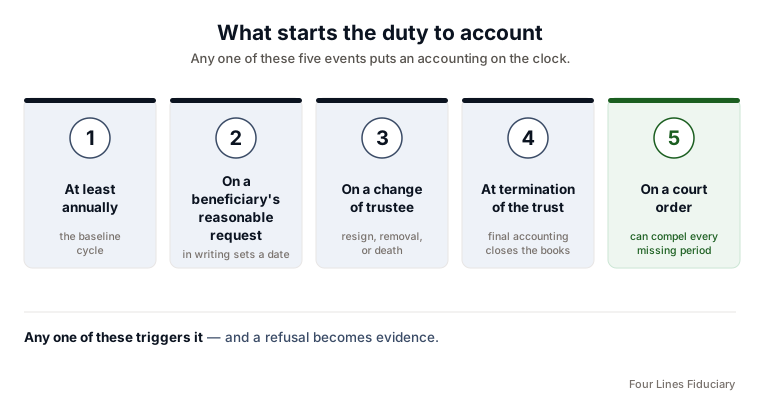
When an accounting is owed: five triggers
The same five events put an accounting on the clock in both states.
- Annually (the baseline). Periodic accountings to the beneficiaries entitled to receive them — not silence until someone complains.
- On reasonable request. A beneficiary can ask. A reasonable request generally must be honored. In writing, it sets a clean date.
- On a change of trustee. When a trustee resigns, is removed, or dies, the departing trustee accounts for their watch so the successor inherits a known starting balance instead of a black box.
- At termination. When the trust ends and assets are distributed, a final accounting closes the books and proves everyone received what they were owed.
- By court order. A court can compel an accounting at any time — and if accountings have lapsed, it can require every missing period, not just the current one.
The trigger dictates the document. A routine annual report mailed to beneficiaries is a different instrument from a court-format accounting filed inside a probate proceeding. For the deadlines tied to each event, see when a trust accounting is required.
DeadlineThe annual report and the court-format accounting run on separate clocks. Satisfying one does not satisfy the other. A court accounting (CA §1061, FL Rule 5.346) has its own schedule. Confirm the date with your attorney before assuming your yearly cycle covers a court filing.
Who can demand one: the beneficiaries, and the right is theirs
The right to an accounting belongs to the beneficiaries — the people the trust exists to serve. The trustee is their agent, not the reverse. The two states draw the entitlement slightly differently:
- California. The duty to keep beneficiaries reasonably informed and to report on request comes from Probate Code §16060–16063, with the annual-account obligation pinned in §16062. The duty runs to the beneficiaries as defined by the instrument.
- Florida. The duty to inform and account runs specifically to the qualified beneficiaries under Florida Statutes §736.0813, and the content and form of a trust accounting are set out in §736.08135.
In both states the trust instrument is an overlay: the document can adjust some of the timing and detail, so what a given beneficiary is entitled to can turn on its terms. Read the instrument first. For the beneficiary's side — how to make the request and how to read what comes back — see our beneficiary's guide to trust accountings.
California vs. Florida: same duty, different plumbing
The two regimes line up on substance. Both require the trustee to keep beneficiaries informed, both expect at least annual accountings, both recognize the same five triggers. The differences are in the statutes, the labels for who's owed, and the court-format rules.
| California | Florida | |
|---|---|---|
| Who is owed | Beneficiaries, per the instrument | Qualified beneficiaries |
| Duty to inform & account | Prob. Code §16060–16063 | Fla. Stat. §736.0813 |
| Annual / periodic accounting | §16062 (annual) | §736.0813 (annual trust accountings) |
| Content & form standard | Court format: Prob. Code §1061 | §736.08135; court format: Fla. Prob. R. 5.346 |
| Core triggers | Annual · termination · change of trustee · demand · court order | Annual · termination · change of trustee · demand · court order |
An accounting prepared to one state's court standard is not portable to the other's — the schedules and content requirements differ. The transparency a beneficiary is owed, though, is materially the same on both sides. For a deeper look at the filing formats, see our note on the California vs. Florida court accounting format.
If you're the trustee: stay current, stay protected
The protective move is to account on schedule rather than wait to be asked.
- Account period by period. Reconstructing five years at once is harder, costlier, and more disputable than producing each year as it closes.
- Keep records behind every line. An accounting that can't be backed by bank and brokerage records is exactly where surcharge and personal liability surface.
- Don't paper over gaps. If a period is missing, rebuild it from source documents before you file.
- Match the format to the trigger. Sending a friendly summary when the court wanted a §1061 / Rule 5.346 filing does not discharge the duty.
Watch outAn accounting with no records behind it is the surcharge trigger. Regular, well-supported accountings are your single best evidence that you did the job. Silence — or a number you can't source — is what a beneficiary's attorney builds a case on.
If you're the beneficiary: it's a right, not a favor
You don't have to wait and hope. You can ask, in writing, for an accounting covering the period you care about — the last calendar year, or everything since the trust was funded. A reasonable request generally has to be answered.
- Put it in writing to the trustee, name the period, and ask for receipts, disbursements, and distributions.
- A refusal is itself meaningful. If a reasonable written request goes unanswered, that silence is evidence, and you have paths to compel.
- You can compel or reconstruct. A probate or trust attorney can force an accounting through the court; an independent accounting built from the actual bank and brokerage records shows what really happened, independent of the trustee's summary.
Common questions
How often does a trustee have to account?
At least annually in both California and Florida, plus at termination and on a change of trustee. A beneficiary can make a reasonable request, and a court can order one at any time. The trust instrument can adjust the timing, so read the document.
Who can demand a trust accounting?
The beneficiaries. In Florida the duty runs specifically to the qualified beneficiaries (§736.0813); in California to the beneficiaries as defined by the instrument (§16060–16063).
What if the trustee won't provide one?
A reasonable written request that goes unanswered is meaningful in itself. A probate or trust attorney can compel an accounting through the court, and an independent reconstruction from source records can show what actually happened.
Does the trust document change when accountings are due?
It can. Both states set a baseline duty to inform and account, but the instrument can modify timing. Read the document, then confirm the deadline with your attorney.
This article is general information, not legal or tax advice, and it does not create an attorney or CPA relationship. Your specific rights, obligations, and deadlines depend on the trust instrument and the laws of your state, and they can vary by court. Confirm the specifics with your own attorney.
Behind, unsure, or staring at a mess?
We turn scattered records into a court-ready accounting — California Probate Code §1061 or Florida Probate Rule 5.346 — with clean GAAP books underneath. We start with a free scope and give you a flat fee before you commit. Never a blind quote.