
AI for Trust & Estate Attorneys: The Accounting Is Where It Actually Pays Off
Most every attorney these days is looking for an AI angle. The pitch decks promise a fully AI-powered firm — drafting complaints, answering motions, and pulling cites on command — and after a lot of trial and error, some firms have made pieces of that real.
But chasing the all-in-one AI office misses what already happened: AI is in your practice right now. Nearly every tool your firm pays for — research, email, document management, billing — runs some AI under the hood. You're benefiting from it whether you bought it that way or not.
So the real question isn't whether to use AI. It's where — and where to keep it on a short leash. This piece is about one practice area where the answer is unusually clear: trust and fiduciary accounting. It's also where a very specific, purpose-built AI architecture quietly changes the status quo.
The AI liability trap in trust accounting
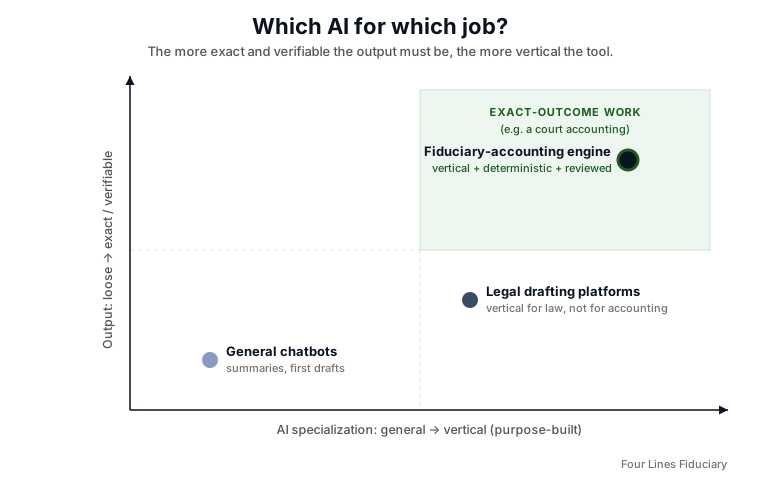
"AI" isn't one tool. Using one type where another belongs is how you end up explaining yourself to an annoyed judge. There are three distinct categories, and failing to tell them apart is where the exposure starts:
| Type | What it's good at | Where it breaks |
|---|---|---|
| General chatbots (ChatGPT, Claude, Gemini) | Quick questions, summaries, first-draft language, limited brainstorming on complex topics | Not safe for confidential client data (consumer tiers retain and train on inputs); hallucinated arithmetic; confident errors in verifiable output |
| Specialized legal platforms (Harvey, Thomson Reuters CoCounsel, Lexis+ with Protégé, Westlaw Precision AI) | Drafting and research with citation-checking, case and matter management | Outside their trained lane — built for law, not court-format accounting |
| AI embedded in tools you already own (email, billing, your accounting software) | Speeding routine work inside that tool | One inch past that tool's job and you'll either get garbage or simply no answer at all |
Use the wrong one and the failure is predictable. Draft a motion in a general chatbot that doesn't check citations and you'll eventually invent a case and draw a sanction. Hand that same chatbot — or the AI baked into your accounting software — a pile of statements and ask for a court-ready financial report, and you'll get something that looks right and isn't.
Watch outTwo risks that are yours the moment you point a general chatbot at a matter. Security & confidentiality: a consumer tool like ChatGPT isn't a safe home for client financials — consumer tiers can retain what you paste and train on it, a confidentiality and privilege problem before a single number is checked. Supervision: you can only supervise what you can evaluate, so if you don't personally work in the §1061 format, your "review" is review in name only, and the duty of technological competence lands on whoever signs. A specialist with a secure pipeline and a credentialed reviewer is exactly how you take both off your own desk.
The mismatchThe mismatch that decides everything: AI is inherently stochastic — ask it the same question twice and it can answer differently, by design. Ask it a slightly different way and you get an entirely different answer. A court accounting is deterministic — one balanced answer that ties to the penny, where a judge can challenge any single line. The best a stochastic tool can do is produce outcomes with confidence limits; it can't natively produce a deterministic, defensible document. The fix isn't a better prompt — it's a different architecture.
Fiduciary accounting isn't one task — it's five
Here's the mistake behind "just point AI at it." A fiduciary accounting isn't a single job. It has to foot to the penny — total charges (property on hand at the start, everything received, gains on sales) must exactly equal total credits (disbursements, losses, distributions, property on hand at the close) — in a statutory format: California Probate Code §1061–1063 with the GC-400/405 Judicial Council forms for conservatorships; Florida Probate Rule 5.346, with guardianships under Fla. Stat. §744.3678. Every line is sourced, allocated between principal and income, and open to challenge by a beneficiary. So it has to be defensible, with a traceable, immutable path from each number back to its source.
Pull that apart and it's really five different kinds of work — and each wants a different tool:
| The job | Best handled by |
|---|---|
| 1. Categorization & first-pass review — what's actually going on in these accounts? | AI — fast first views, flagged with confidence limits |
| 2. Footing & tracing — every number ties to the penny, back to a source | Rules / deterministic code, not AI. The AI doesn't control the math — heuristics do. |
| 3. Statutory classification — principal vs. income, the right §1061 schedule | Mostly rules, with AI help on the grey-area calls |
| 4. Presentation & traceability — court formats, custom views, the schedules | AI is good at wiring structured data into standard reports and views |
| 5. Human defense — objections, disputes, the judge's questions | A human — the buck stops with the preparer |
Notice what that means. Steps 2 and 3 are exactly where a probabilistic model is the wrong primary tool: a chatbot that's 99% right is still wrong, because one unexplained transfer is what a hostile beneficiary builds a surcharge claim around. Integrity tasks don't degrade gracefully — they tie out, or they don't. (And when new facts surface mid-engagement — a vendor's real nature, an account nobody mentioned — the right system pushes that correction across every affected account at once, consistently, instead of you re-touching dozens of entries by hand.)
So doing this efficiently today isn't a choice between AI, rules, or people. It's about orchestrating all three: large language models for extraction and first cuts, expert/rules-based systems for footing and statutory mapping, and human checkpoints where judgment and accountability live. That orchestration is the architecture.
Don't replace your process with AI — replace it with human-in-the-loop AI
This is the move most firms get backwards. The win isn't handing the accounting to a chatbot and hoping. It's replacing the old manual process — the weeks of hand-keying statements and reconciling by hand — with a modern, human-in-the-loop AI system: models and rules do the grind, and a qualified person owns every judgment call and signs the result.
Done right, that doesn't just de-risk the work. It changes the economics of a court mandate you already have to fulfill. The time and the cost of getting an accounting filed drop sharply, because the machine eats the reconstruction-and-format grind that used to run up open-ended hourly time.
There's also a structural reason the human never leaves. Someone has to be accountable to the judge and the beneficiaries. A court isn't going to accept an AI-attested filing any time soon — an institutional limit, not a technical one. The accountable human is the product, not scaffolding you remove later; it's the same rigor a contested insolvency reorganization demands.
The division of labor is clean:
- Stays with you: strategy, the trust instrument, the contested allocation calls, the client relationship.
- Hand it off: the reconstruction-and-format grind, where a purpose-built engine plus a qualified reviewer beats open-ended hourly time every time.
Four Lines Fiduciary: the institutional back office
That hand-off is what we're built for. Four Lines Fiduciary delivers an institutional-grade automated reporting structure. We're the back office that makes "yes, we use AI" true — without putting your license behind a chatbot's arithmetic.
Send us the raw inputs — a QuickBooks export, bank and brokerage statements, Quicken, Excel, or a literal banker's box of disparate paper. Orchestrated extraction models structure the data, deterministic code foots and reconciles it, and a credentialed financial professional reviews every allocation. Your client data never touches a consumer chatbot. We return a court-ready accounting in the §1061 or Rule 5.346 format, plus clean GAAP books and workpapers.
We scope every matter up front and quote a flat fee before you commit — never a blind hourly meter. Send us what you have, and we'll tell you what the accounting needs and what it costs to file.
Common questions
Can I use ChatGPT to prepare a trust accounting?
Not for the document itself. A general chatbot is stochastic — ask the same question twice and it can answer differently — while a court accounting is deterministic and must foot to the penny, with every line open to a judge's challenge. A chatbot that's 99% right is still wrong, because one unexplained transfer is what a hostile beneficiary builds a surcharge claim around. AI is genuinely useful for first-pass categorization and wiring structured data into reports, but the footing and statutory classification belong to deterministic rules with a qualified human signing off.
Is it safe to put client financial data into a general AI tool?
Consumer tiers of tools like ChatGPT can retain what you paste and train on it, which is a confidentiality and privilege problem before a single number is checked. Client financials don't belong in a consumer chatbot. A specialist with a secure pipeline keeps your client data out of consumer tools entirely, and a credentialed reviewer takes the supervision duty off your desk.
Where does AI actually help in fiduciary accounting?
A fiduciary accounting is really five different jobs. AI is the right tool for categorization and first-pass review, and for wiring structured data into court formats and custom views. Footing and tracing belong to deterministic rules, statutory principal-versus-income classification is mostly rules with AI help on grey-area calls, and human defense — objections, disputes, the judge's questions — stays with the accountable preparer. The win is orchestrating all three, not handing the whole job to a chatbot.
General information for trust and estate practitioners — not legal or tax advice, and not an attorney or CPA engagement. We prepare fiduciary accountings; we don't provide legal advice or represent clients. Requirements vary by court and by the governing instrument; confirm specifics with counsel of record.
Make "yes, we use AI" true — without putting your license behind a chatbot.
Send us what you have. We'll tell you what the accounting needs and quote a flat fee before you commit — never a blind hourly meter.