
Six ways to get messy financial records accounted for — and which one is most likely to survive probate
Sooner or later someone hands you a pile of financial records and says "make sense of this." A business three years behind. A nonprofit whose treasurer vanished. A trust nobody reconciled. The records are raw — bank and brokerage statements, a shoebox, a half-built QuickBooks file — and there's no clean ledger to start from.
There are six realistic ways to get that done, and they are not interchangeable. The right one depends almost entirely on one variable: how messy the data is, and whether anyone is still around to explain it.
Which is why probate is the ultimate stress test. In a decedent's estate, the one person who knew what every transfer meant — why $40,000 moved, what that check was for — is gone. No option that quietly depends on someone explaining the records survives that. Here's the honest rundown of all six, what each costs, what each can and can't do, and where each one breaks.
The short version
- DIY (Excel): cheapest in dollars, most expensive in hours and risk. Fine for a handful of clean accounts; it collapses on volume and on any court format.
- A bookkeeper: great at ongoing books, billed hourly. Reconstruction is the meter's worst enemy, and most don't do court/fiduciary formats.
- Your CPA: owns the tax return. Most would rather start from clean books than dig through a shoebox, and bill the dig at full rate.
- Dedicated software (ONESOURCE, GEMS, TEdec): produces the court formats — but it's built for firms, priced accordingly, and assumes you feed it a clean, classified ledger. It formats; it doesn't reconstruct.
- A cleanup/catch-up service: good for behind-but-explainable business books; not built for principal-and-income or a court accounting.
- A fiduciary-accounting specialist: reconstructs from raw records and delivers the court format — the option built for the probate case where no one is left to explain.
The one question that picks the tool
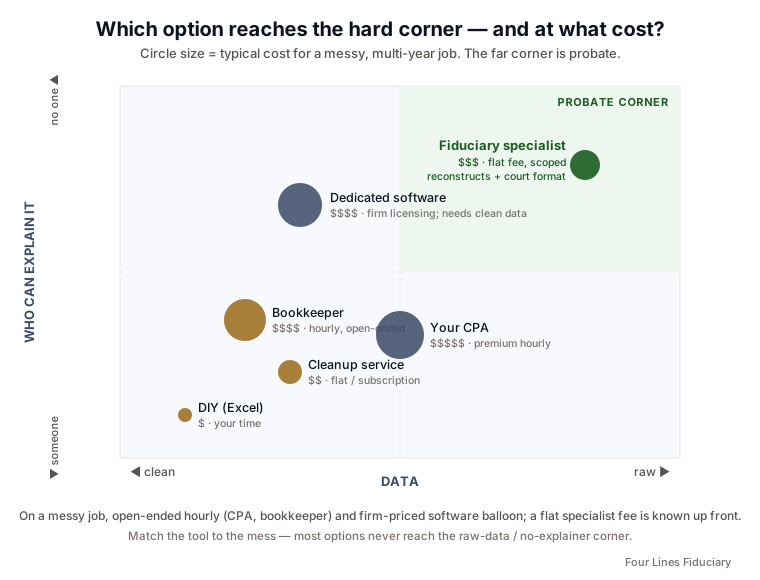
Before the options, name your situation honestly on two axes:
- How raw is the data? A clean QuickBooks file is a different job from a banker's box of statements with missing months and commingled accounts.
- Is anyone around to explain it? A business owner who can answer "what was this $9,000 for?" changes everything. In probate, that person is dead — and a beneficiary's attorney will challenge every line you can't source.
The further you sit toward raw data + no one to explain it, the fewer options actually work. Probate sits at the far corner. Keep that corner in mind as you read.
The six options, side by side
| Option | Cost model | Reconstructs from raw records? | Produces a court / fiduciary format? | Handles the "no one to explain it" (probate) case? | Best fit |
|---|---|---|---|---|---|
| DIY (Excel) | Your time | Only you can, by hand | No | No | A few clean accounts, short period, low stakes |
| Bookkeeper | Hourly | Sometimes — slowly | Rarely | Weakly | Ongoing books; modest catch-up with an owner to ask |
| Your CPA | Hourly (premium) | Can, at full rate | Tax returns, not court schedules | Partially | The 1041/541 and tax strategy |
| Dedicated software | License/seat (firm-priced) | No — assumes a clean ledger | Yes | No (it's a tool, not a preparer) | Firms with staff and clean data |
| Cleanup / catch-up service | Flat or subscription | Yes, for business books | No (no principal/income, no court format) | Weakly | Behind-but-explainable business books |
| Fiduciary specialist | Flat fee, scoped | Yes, from raw records | Yes (§1061 / Rule 5.346) | Yes — built for it | Messy, multi-year, probate, no explainer |
1. Do it yourself in Excel
Cheapest in dollars, most expensive in hours and exposure. For a few clean accounts over a short window, a spreadsheet is a legitimate answer — you control it and you pay nothing.
It falls apart on two things: volume and format. A real estate or multi-year matter is hundreds of transactions across several accounts, and you are hand-coding every rule and every total. And a spreadsheet is not a court schedule — no charges-equal-credits proof, no principal-and-income split. If the output has to satisfy a judge or a hostile beneficiary, DIY is where most people start and where most of them stall. (See how a court accounting is actually prepared.)
2. A bookkeeper
Bookkeepers are genuinely good at what they're built for: keeping clean books current, month to month. The mismatch is the work type and the meter. Reconstruction — turning raw statements into a ledger that didn't exist — is the most expensive thing to bill by the hour, because nobody can estimate the hours until they're deep in it. And most bookkeepers have no concept of fiduciary principal vs. income or a court format; that's not a knock, it's simply not the job they trained for.
A bookkeeper fits a modest catch-up where the books mostly exist and an owner is around to answer questions. Push past that and the open-ended hourly bill is the risk.
3. Your CPA
Your CPA owns the tax return — Form 1041 for a trust or estate, plus the state return — and should. But two realities matter for messy data:
- Most CPAs would rather start from clean books than excavate a shoebox, and they bill the excavation at their full professional rate. The reconstruction is the expensive 90%; the return is the last 10%.
- A tax return is not a court accounting. Taxable income groups transactions by tax character; a court accounting groups them by whose money it is and proves charges equal credits. Same data, incompatible structures. (Why your CPA isn't the tool for the court accounting — and how to use them anyway.)
Keep the CPA on the tax side. The reconstruction and court format is a different specialty.
4. Dedicated fiduciary-accounting software
The real software exists and it's capable. The established players:
- Thomson Reuters ONESOURCE Fiduciary Accounting — the enterprise standard; ships state-specific court formats (including California §1061 and Florida Rule 5.346).
- GEMS — the Gillett Estate Management Suite (GEMAcct, plus GEM706/GEM709), now cloud-based; built to the National Fiduciary Accounting Standards.
- TEdec — long-running trust-and-estate administration software, and a service bureau if you'd rather hand the work off.
These produce the formats correctly. Two honest catches: they're priced and built for firms (trust departments, banks, large T&E practices), often into the thousands per year; and — the part most buyers miss — they assume you feed them a clean, correctly classified ledger. They format; they do not reconstruct a banker's box for you. The hard 90% is still on you. (More in the fiduciary accounting software buyer's guide.)
Watch out — "AI bookkeeping" for the numbers A wave of tools now advertise AI that "does the accounting." For ongoing categorization, fine. For a court accounting, the math must be deterministic — it ties to the penny and survives line-by-line challenge. A model that answers differently between runs can't produce a defensible document. AI is right for reading statements and first-pass classification; it should never own the arithmetic.
5. A cleanup / catch-up bookkeeping service
A category of flat-fee or subscription services exists to fix "behind" business books — months of unreconciled transactions turned current. For an ordinary business that fell behind, with someone who can still explain the unusual items, these can be a good fit.
They are not built for fiduciary work. No principal-and-income allocation, no §1061 / Rule 5.346 court schedules, and — critically — they generally assume the client can answer questions about the records. Hand them a probate matter and both assumptions fail.
6. A fiduciary-accounting specialist
This is the option built for the far corner of the grid: raw records, multi-year, commingled, and often no one left to explain them. A specialist reconstructs the ledger from whatever exists — statements, exports, a shoebox — separates principal from income under UFIPA, proves charges equal credits to the penny, and delivers it in the court format your state accepts (CA Probate Code §1061–1063; Fla. Prob. R. 5.346). Then hands the clean books to your CPA for the return.
The trade-off is that it's a specialty, so it's not the cheapest line item for a simple, clean, explainable set of books — a bookkeeper or DIY wins there. It earns its keep precisely when the other five options break.
The records that quietly break every tool
Some data sources are where DIY, cheap software, and generalists fail without telling you — and where a messy estate gets genuinely hard:
- Brokerage accounts. Reinvested dividends, stock splits, spin-offs, and date-of-death cost basis turn one account into hundreds of line items. A capital gain is principal on the accounting but taxable income on the 1041 — get the basis wrong and you misstate it for both the court and the IRS. (Carry value vs. market value, and why a gain is principal →)
- Quicken and QuickBooks files. A half-built Quicken or QuickBooks file feels like a head start, but importing a file is not a court accounting. The principal-and-income split and the charges-equal-credits proof aren't in there, and one wrong category multiplies across years. (Can QuickBooks do a trust accounting? →)
- Venmo, PayPal, Zelle, Cash App — the new nightmare. Money now moves outside the bank statement's narrative. A $3,000 Venmo transfer lands as one cryptic line; the real story — who got it and what for — lives in a separate app nobody exports. Bank-feed importers and many bookkeepers read these poorly, so the transfers either vanish or get miscategorized. In an estate, every unexplained peer-to-peer transfer is a surcharge waiting to happen — and the deceased is the only person who knew what it was for.
This is exactly why the "how raw is the data" axis matters: a clean checking account is easy; a brokerage account plus a decade of Venmo and a half-finished Quicken file is the job that separates the six options.
The probate test: why "no one to explain it" changes everything
Run each option against the case where the person who knew the records has died:
- DIY: you're reconstructing a stranger's financial life from paper, by hand, into a format you've never built. Most people can't finish it.
- Bookkeeper / cleanup service: both lean on someone answering "what was this for?" In probate, no one can.
- CPA: can file the return, but the court accounting and the unexplained-transaction problem aren't their lane.
- Software: can't help — there's no clean ledger to load, and the tool doesn't do reconstruction.
- Specialist: this is the design case. Every transaction gets sourced to a document, because in probate an unsourced number is exactly what a beneficiary's attorney turns into a surcharge claim — and the burden is on the fiduciary to prove every item.
That's the whole point of naming probate as the ultimate test: it's the case with the least help and the highest stakes, and it filters the six options down to the one or two that actually hold.
How to choose, in one line Clean books + someone to explain them → DIY or a bookkeeper. A firm with staff and clean data → dedicated software. A behind-but-explainable business → a catch-up service. Raw records, multi-year, a court format, or a probate matter with no one to ask → a fiduciary specialist. Match the tool to the mess, not to the logo.
FAQ
What's the difference between a bookkeeper and a fiduciary-accounting specialist?
A bookkeeper keeps clean books current and bills by the hour; most don't do principal-and-income allocation or court formats. A fiduciary specialist reconstructs a ledger from raw records, separates principal from income under UFIPA, and produces a court-format accounting (CA §1061 / Fla. R. 5.346) — the job a bookkeeper isn't trained for.
Can accounting software do a probate or trust accounting by itself?
It can produce the court format, but only from a clean, correctly classified ledger you feed it. Tools like ONESOURCE, GEMS, and TEdec format; they don't reconstruct a box of statements. In probate — no clean ledger and no one to explain the records — the reconstruction is the actual work, and software doesn't do it.
Why is probate the hardest case for messy records?
Because the person who knew what the transactions meant has died. Every option that quietly relies on someone answering "what was this for?" fails. The records must be rebuilt and sourced to documents, because in a contested estate an unexplained transaction shifts the burden onto the fiduciary and invites a surcharge.
Can't I just have my CPA do all of it?
Keep your CPA on the tax return — that's their lane, and they're good at it. But most CPAs would rather start from clean books than excavate a shoebox, and they bill the excavation at full rate. The reconstruction and the court format are a separate specialty; the cleanest setup is a specialist who hands your CPA reconciled, 1041-ready books.
How much does each option cost?
DIY costs your time; bookkeepers and CPAs bill hourly (reconstruction is open-ended because no one can estimate it up front); dedicated software is firm-priced licensing; catch-up services are flat or subscription; a fiduciary specialist quotes a flat fee scoped to your records. For messy or court-bound work, a fixed price beats an open hourly meter. (What a trust accounting costs →)
Where we fit
We're the sixth option — the fiduciary-accounting specialist for the messy, multi-year, probate, no-one-left-to-explain-it cases. Bring us whatever you have: a QuickBooks export, bank and brokerage statements, a literal box of paper. We reconstruct the ledger, separate principal from income under UFIPA, prove charges equal credits, and deliver a court-ready accounting (CA §1061–1063 or Fla. Prob. R. 5.346) plus clean books for your CPA's return.
We scope every engagement before you commit a dollar and quote a flat fee — never a blind hourly meter. If a bookkeeper or DIY is genuinely the better fit for your situation, we'll tell you that too. (Get a free scope →)
This is general information, not legal or tax advice, and not an attorney or CPA engagement. The right option depends on your records, your jurisdiction, and the governing instrument; confirm specifics with your attorney or CPA. Product names and capabilities are current as of writing and may change.
Not sure which option fits your records?
We scope every engagement before you commit a dollar — and we'll tell you if a bookkeeper or DIY is the better fit.