
You're the executor or trustee and inherited a shoebox of records. Do these five things first.
Someone who trusted you died, and what they left you is a box. Maybe an actual shoebox of bank statements. Maybe a drawer of unopened mail and a sticky note with fifteen brokerage and bank logins on it. You're the executor of the estate, or trustee of the trust, and you've just learned you now owe a tax return — and possibly a court accounting — for property you didn't manage and accounts you've never seen.

That's the normal way these jobs start. Almost nobody leaves a tidy labeled binder. Here are the five moves that get you out of the fog, the two deadlines that ambush new executors, and an honest account of why the hard part is hard.
The short version
- Secure everything before you understand anything. A single forgotten statement can be the only proof an account existed.
- Stop the automated bleed. Kill recurring subscriptions and auto-drafts immediately, before your date-of-death cash baseline drifts.
- Build two lists: an asset inventory and an access list (logins, keys, safe-deposit boxes). Use the decedent's last tax return as a ghost map.
- Pin down date-of-death values. They're the opening balance for both the tax return and the accounting.
- You owe two separate things: a fiduciary income-tax return (Form 1041) and, often, a court/beneficiary accounting. One does not cover the other.
- The mess is reconstructable. Missing periods, commingled funds, and principal-vs-income are the parts that take a specialist.
Step 1 — Secure the records before you sort them
Your first job isn't to understand the records. It's to not lose them.
- Pull everything into one place: the shoebox, the loose mail, the laptop with saved passwords, the locked filing cabinet.
- Throw nothing away, even what looks like junk. A statement from a closed account may be the only evidence that account ever existed.
- Stop the automatic bleed immediately. The day someone dies, their checking account turns into a leaky bucket. Netflix, the gym, the cloud storage, the pest-control plan, the digital paper — they all keep auto-drafting. Every one of those post-death charges is property leaving the estate without authority, and it's you who has to explain it later. Find the cards, call the numbers, freeze the recurring billing, so your date-of-death cash baseline stops moving.
- Start a single running list — a notebook or one spreadsheet. You're becoming the person who knows where things are, and that starts with writing down what you have.
Step 2 — Inventory the assets and the access separately
Build two lists, because they answer two different questions: what is there, and how do I reach it.
Asset inventory — every bank account, brokerage and retirement account, real-estate parcel, vehicle, and insurance policy. For each: institution, account number if you have it, and a rough value.
Access list — every login, username, and password for those scattered accounts, plus safe-deposit boxes and physical keys. You don't have to log into everything today. You need to know what exists and how to get in later.
Write down the gaps as you find them: an account you know existed but have no statement for, a login that no longer works. Knowing what's missing is worth as much as knowing what you have — the missing pieces are what a court will later ask about.
The ghost map: their last tax return. Pull the decedent's most recent Form 1040 and turn to Schedule B (Interest and Ordinary Dividends). If Schedule B reports $42 of interest from "First National Bank" but there isn't a single page from First National in the shoebox, you just found an account nobody told you about. Every payer of interest or dividends is listed there — it's the closest thing to a master list of the financial accounts you'll get.
The wall of silence: you need the Letters first. Until the probate court issues your Letters Testamentary (with a will) or Letters of Administration (without one), a bank's fraud department treats you as a stranger asking about a dead person's money — and won't tell you a balance or hand over a statement. Don't burn days on hold today. Put the logins in your spreadsheet, keep certified death certificates safe, and work with your probate attorney to get the Letters. That's the key that unlocks the doors, and getting it can take weeks.
Hint. Sort statements into one folder per account, oldest to newest, before you try to read any of them. Laid out that way, the missing months announce themselves — a gap in the sequence is obvious in a way it never is in a loose pile.
Step 3 — Pin down the date-of-death values
Two numbers outrank all the others, and both are tied to a single day: the date your loved one died.
- Value as of the date of death. This is the opening balance for everything that follows — it anchors the tax return and the accounting alike. Bank and brokerage statements covering that date usually show it. A house or a unique asset may need an appraisal.
- Everything from that day forward. Gather every statement, every account, every month, from the date of death on. This is where the shoebox earns its keep and where the gaps surface.
Watch out — the weekend trap. For a publicly traded stock, the date-of-death value isn't the closing price. It's the mean of that day's high and low — and if the death falls on a weekend or holiday, when no trading happened, it's a weighted average of that high-low mean on the nearest trading day before and the nearest after, tilted toward the closer day (Treas. Reg. §20.2031-2(b)). A Saturday death values a share at roughly two-thirds Friday's mean plus one-third Monday's. Look up Friday's closing price on a finance site and type that into your inventory, and a sharp CPA or a probate auditor will hand it back.
Step 4 — Know the two deadlines that sneak up on you
New executors routinely discover they owed something only after it was late. You owe two separate things, and the difference matters.
| The fiduciary tax return | The court / beneficiary accounting | |
|---|---|---|
| What it is | Reports income the estate or trust earned after the date of death | A formal financial report of what you did with the property |
| Who it's for | The IRS (and the state tax agency) | Beneficiaries, and in supervised matters the probate judge |
| The form | Federal Form 1041; CA Form 541 | CA Probate Code §1061–1063 schedules; FL Fla. Prob. R. 5.346 |
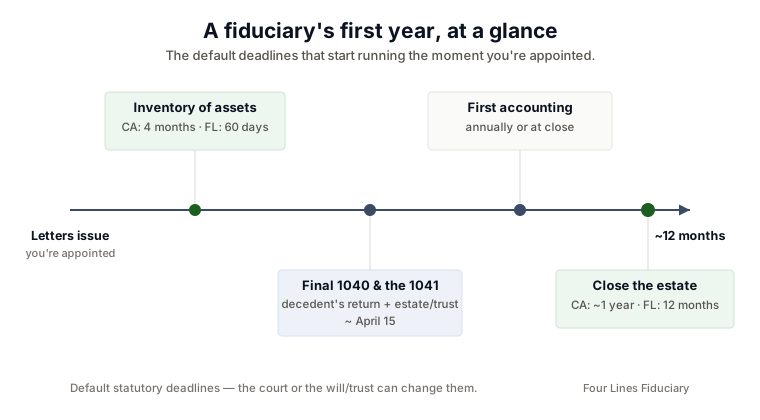
| When | The 1041 is due the 15th day of the 4th month after the tax year ends (≈ April 15 for a calendar year) | Set by the will/trust instrument and the type of proceeding — annual, on final distribution, or on demand |
| The test | Income reported correctly | Total charges must equal total credits, to the dollar |
The tax return tells the government what the estate earned. The accounting tells the beneficiaries and the court what you did with the money. Don't assume one covers the other. They don't, and the deceased person's final personal return (their last 1040) is a third, separate filing on top of both. (When is a trust accounting required? →)
The exact due dates ambush new fiduciaries, and they differ by state. We keep the full side-by-side chart — inventory, periodic accountings, closing the estate, the 1040/1041/541, and estate tax — on one page. Read them as defaults: a court order or the will/trust can shorten them, and a beneficiary can demand an accounting sooner.
See the full California & Florida probate deadline chart →
Step 5 — Know where it gets genuinely hard
The lists above are work, but they're doable at a kitchen table. The difficulty lives one layer down. Knowing it's coming keeps it from ambushing you.
- Missing statement periods. A closed account, a bank that merged, a year no one saved. Banks and brokerages can often reissue historical statements, but tracking down which months are gone — and proving the balance carried correctly across the gap — is real work.
- Commingled funds. If estate money and personal money ever shared an account, every transaction has to be traced and assigned. A single account used for both groceries and trust expenses can take longer to untangle than ten clean ones.
- Principal versus income. Fiduciary accounting splits every dollar into principal and income under a specific rulebook — the Uniform Fiduciary Income and Principal Act (UFIPA: Cal. Prob. Code §16320 et seq.; Fla. Stat. Ch. 738). Interest, dividends, and rents are generally income; the assets and gains on their sale are generally principal; entity distributions, fees, and accruals take judgment. It's the piece generalists most often get wrong, and it changes who gets paid what. (More on principal vs. income →)
- Charges must equal credits. A court accounting isn't a bank printout. Total charges — what you started with, plus everything received — must equal total credits — everything disbursed, distributed, and still on hand — to the dollar. If it's off by a penny, the court sends it back. (How a trust accounting is prepared, step by step →)
Watch out. A balance that doesn't reconcile is where personal liability lives. If you can't show where money went, a court can hold you responsible for the gap. That's not a reason to panic — it's the reason to get the reconstruction right rather than fast.
When to hand off the hard part
There's a clean line between what only you can do and what a specialist should do.
- Only you can: secure the records, stop the auto-pay bleed, build the inventory, list the accounts and logins, find the date-of-death statements. Do these first, no matter what you decide next.
- A specialist should: reconstruct a court-ready ledger from mixed statements, recover missing periods, separate principal from income, and prove charges equal credits.
That second list is our work. You bring the shoebox, the folder, and the logins; we reconstruct the ledger, split principal from income, and deliver a court-ready accounting — CA Probate Code §1061–1063, or Fla. Prob. R. 5.346 depending on your state — plus clean books your attorney and CPA can rely on. We assess what you have first, tell you honestly what's missing, and quote a flat fee before you commit a dollar — never a blind hourly quote that balloons.
This is general information, not legal or tax advice, and not an attorney or CPA engagement. Deadlines, filing requirements, and the rules that apply vary by court and by the will or trust instrument; confirm specifics with your attorney or tax advisor.
You bring the shoebox. We build the accounting.
We assess what you have first, tell you honestly what's missing, and quote a flat fee before you commit a dollar.